Home / Guides / What Does Moneyline Mean in Betting?
Betting basics
What does moneyline mean in betting?
A moneyline bet is a wager on the outright result of a game, match, or event. Instead of covering a point spread, your selection simply has to satisfy the moneyline's win condition.

On this page
- Moneyline meaning in betting
- Positive vs. negative moneyline odds
- Moneyline examples
- How moneyline payouts work
- Moneyline implied probability
- Favorite vs. underdog
- Moneyline vs. point spread
- How moneylines differ by sport
- How to place a moneyline bet
- Why shopping the moneyline matters
- Common moneyline mistakes
- Responsible moneyline betting
- Moneyline FAQ
What does moneyline mean in betting?
A moneyline is a sports betting market built around the outright result rather than a scoring handicap. If you bet a team on the moneyline, you are generally betting that team to win according to the market's settlement rules. You do not need the team to win by a certain number of points, runs, goals, sets, or games unless those conditions are specifically part of another market.
That simplicity is why the moneyline is often one of the first bet types new bettors encounter. A football moneyline may ask which team wins the game. A baseball moneyline asks which team wins under the operator's baseball rules. A tennis moneyline usually asks which player wins the match. The basic idea is consistent even though the sport-specific grading details can differ.
The word moneyline also refers to the odds attached to the selection. If a sportsbook lists Team A -180 and Team B +155, those numbers are the moneyline prices. They tell you both the potential reward and the market's implied view of each outcome. The selection and the price belong together: “Team A moneyline” is incomplete if you ignore whether the offered price is -150, -180, or -220.
There is one important exception to the shortcut “moneyline means pick the winner.” Some sports can finish in a draw, and sportsbooks may offer either a two-way or three-way market. In a three-way moneyline, commonly shown as 1X2 in soccer, home win, draw, and away win are all separate selections. In a two-way market, tie or overtime treatment depends on the posted rules. Always read the market title and settlement terms before assuming how a draw will be handled.
The moneyline focuses on the outright result rather than a handicap such as -3.5 or +7.
A favorite can be likely to win but expensive to bet; an underdog can be less likely but offer a larger payoff.
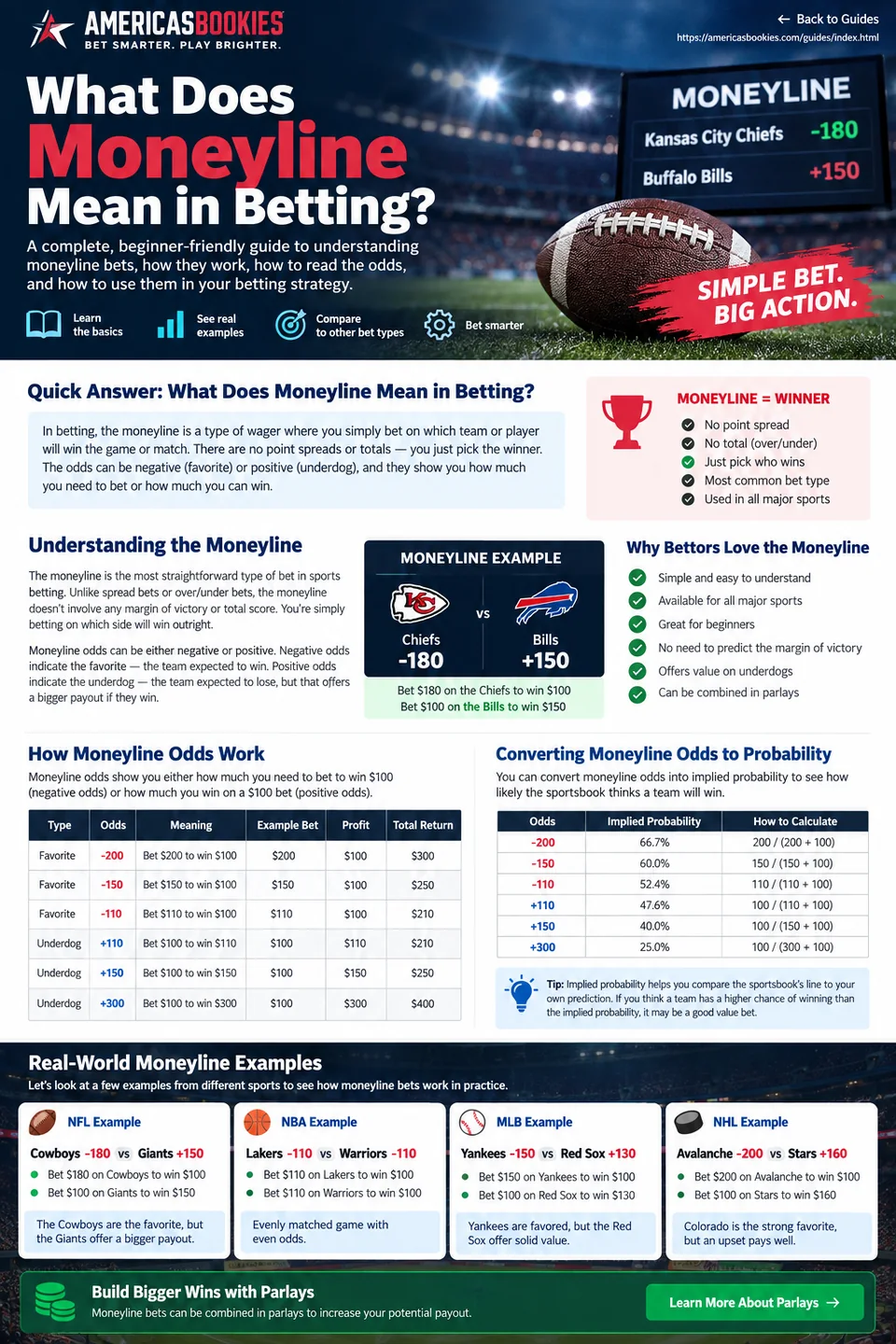
Positive American odds show profit on a $100 stake; negative odds show the stake needed to make $100 profit.
Overtime, ties, listed pitchers, retirements, and other sport-specific rules can affect settlement.
What do positive and negative moneyline odds mean?
U.S. sportsbooks commonly display moneylines in American odds. These prices carry either a plus sign or a minus sign. The sign does not tell you whether a bet is “good” or “bad.” It tells you how the price is expressed around a $100 reference point.
Negative moneyline
-150
Usually the favorite. At the standard scale, you would risk $150 to make $100 profit.
Positive moneyline
+150
Usually the underdog. A $100 winning stake would make $150 profit.
Negative moneyline odds tell you how much would need to be staked to produce $100 in profit. At -200, the standard illustration is $200 risked for $100 profit. At -125, it is $125 risked for $100 profit. You do not have to bet those exact amounts; the sportsbook scales the return to your actual stake.
Positive moneyline odds tell you how much profit a $100 winning stake would produce. At +200, a $100 stake would make $200 profit. At +125, a $100 stake would make $125 profit. Again, a $10, $25, or $40 stake scales proportionally.
When the teams or players are close to evenly matched, you may see prices near -110 on both sides, or one side around -105 and the other around -115. A true “pick'em” can appear around even money, though the sportsbook's margin means the exact quotes may not sit at +100 on both sides.
If American odds are unfamiliar, our guide to understanding odds and betting lines explains American, decimal, and fractional formats in more detail.
Moneyline betting examples
The easiest way to understand the market is to work through several prices. These examples focus on profit and total return. Profit is the amount won above your stake. Total return is the profit plus the original stake returned after a winning bet.
| Moneyline | Typical label | Example stake | Profit if it wins | Total return |
|---|---|---|---|---|
| -250 | Strong favorite | $100 | $40 | $140 |
| -150 | Favorite | $100 | $66.67 | $166.67 |
| -110 | Slight favorite / near even | $100 | $90.91 | $190.91 |
| +100 | Even money | $100 | $100 | $200 |
| +150 | Underdog | $100 | $150 | $250 |
| +300 | Large underdog | $100 | $300 | $400 |
Example 1: betting a -150 favorite
Suppose a basketball team is -150 on the moneyline and you stake $60. The standard -150 quote means $150 risked would produce $100 profit. A $60 stake therefore produces $40 of potential profit. If the team wins under the moneyline rules, your total return is $100: the $60 stake plus $40 profit. If the team loses, your $60 stake is lost.
Example 2: betting a +180 underdog
Now suppose an underdog is +180 and you stake $50. Positive odds are simpler to scale: $50 × 1.80 = $90 potential profit. A winning ticket would return $140 total — your $50 stake plus $90 profit. The bigger potential payoff reflects the lower implied chance assigned to that side by the price.
Example 3: two sides with different prices
Imagine a baseball game where the home team is -135 and the road team is +120. You are not choosing between two equal payouts. The favorite costs more because the market prices it as more likely to win. The underdog pays more because the market prices it as less likely. Your job is not just to ask “Who wins?” but “Is the offered moneyline a fair enough price for the chance I think this team has?”
How do moneyline payouts work?
The payout formula changes depending on whether the American odds are positive or negative. You can let the sportsbook calculate it, but knowing the formula helps you catch misunderstandings and compare prices.
Positive moneyline payout formula
For positive odds, potential profit is:
At +150, a $40 stake makes $60 profit if it wins. At +250, the same $40 stake would make $100 profit. The higher positive number creates a larger payoff but represents a lower implied probability.
Negative moneyline payout formula
For negative odds, use the absolute value of the moneyline:
This is why a -300 favorite can be expensive: a $100 stake would produce only $33.33 in profit. It does not mean the favorite is a poor selection by definition. It means the market is asking you to accept a smaller reward in exchange for the higher win probability implied by the price.
Also check what the bet slip labels as payout, to win, or potential return. Some interfaces display profit only; others display stake plus profit. Our bet slip guide shows what to verify before you press confirm.
How moneyline odds translate to implied probability
Moneyline odds are prices, but every price can be translated into an implied probability. This is the break-even probability before accounting for your own estimate of the event and, in a two-sided market, before removing the sportsbook's built-in margin.
For positive American odds, implied probability is 100 ÷ (odds + 100). For negative American odds, it is |odds| ÷ (|odds| + 100).
| Moneyline | Implied probability | Plain-English reading |
|---|---|---|
| -300 | 75.0% | The price implies roughly a three-in-four chance before adjusting for margin. |
| -200 | 66.7% | About two chances in three. |
| -150 | 60.0% | A clear favorite, but far from certain. |
| -110 | 52.4% | Slightly above a 50/50 break-even point. |
| +100 | 50.0% | Even money. |
| +150 | 40.0% | The price implies a two-in-five chance. |
| +300 | 25.0% | The underdog is priced around one chance in four. |
The probabilities on both sides of a sportsbook market often add up to more than 100%. That extra percentage is related to the sportsbook's margin, commonly called the vig or hold. For example, if two sides are both -110, each has a raw implied probability of about 52.4%. Together they total about 104.8%, not 100%.
This is a key reason that “the favorite is more likely to win” is not enough to justify a moneyline bet. A -250 favorite can still be overpriced if you believe its true win probability is lower than the price implies. An underdog can lose more often than it wins and still be attractively priced if the payout is large enough relative to its true chance.
That idea is the foundation of finding value in a betting line: compare the market's break-even probability with a well-reasoned estimate of the actual chance, rather than treating “likely winner” as synonymous with “good bet.”
Moneyline favorite vs. moneyline underdog
The favorite is the side priced as more likely to win. In American odds, the favorite normally carries a negative moneyline. The underdog is the side priced as less likely and normally carries a positive moneyline.
Those labels describe the market price, not certainty. A -400 favorite can lose. A +300 underdog can win. The moneyline expresses a tradeoff between probability and reward: as the market considers a side more likely to win, the price becomes more expensive and the profit per dollar staked becomes smaller.
One common beginner mistake is thinking that betting favorites is inherently safer. The favorite does win more often at a given price level, but a bettor may have to risk substantially more to earn the same amount of profit. Repeated losses on expensive favorites can erase several smaller wins. The relevant question is whether the odds are favorable relative to the true chance, not whether the selection has a minus sign.
The opposite mistake is chasing large plus-money payouts because they look exciting. A +500 underdog offers a big return because the implied probability is low. You do not gain an advantage simply by choosing the largest positive number on the board. The payout and probability must be evaluated together.
Moneyline vs. point spread: what is the difference?
A moneyline and a point spread can be offered on the same game but they ask different questions. The moneyline asks who wins under the market rules. The spread applies a handicap before determining which betting side wins.
| Feature | Moneyline | Point spread |
|---|---|---|
| Main question | Who wins outright? | Who covers the handicap? |
| Example | Favorite -180 | Favorite -4.5 (-110) |
| Margin matters? | Usually no, as long as the selected side satisfies the outright result rules. | Yes. The score margin is central to grading. |
| Favorite price | Can become strongly negative. | Often stays near a standard price while the handicap changes. |
| Best for learning | Simple win-condition concept. | Useful for understanding handicaps and margin of victory. |
Suppose a football favorite is -250 on the moneyline and -6.5 at -110 on the spread. A one-point win would cash the moneyline but lose the -6.5 spread. The spread offers a more balanced price because it asks the favorite to win by a larger margin. The moneyline removes the handicap, but the price becomes more expensive.
Neither market is automatically better. They are different contracts. The best comparison is based on the exact odds, your estimate of each outcome, and how much risk you are prepared to take. For a broader comparison of moneylines, spreads, totals, props, and futures, see our types of sports bets guide.
How moneyline betting differs by sport
The core concept is stable, but settlement rules are not identical across sports. Before placing a moneyline, look beyond the headline price and make sure you understand what counts as the official result.
- NFL and basketball: moneylines generally focus on the winner, with overtime commonly included unless the market says otherwise. Rare tie scenarios are handled under the sportsbook's rules.
- MLB: moneyline rules can interact with starting-pitcher listings, shortened games, postponements, and operator-specific action rules. Read the baseball house rules, especially for unusual game conditions.
- NHL: a standard two-way moneyline often includes overtime and shootouts, while regulation-only markets treat the 60-minute result separately. A “regulation moneyline” is not the same bet as a full-game moneyline.
- Tennis: match-winner moneylines are common, but retirements and walkovers can trigger special settlement rules. A book may require a certain amount of play before grading the market.
- MMA and boxing: the moneyline usually means picking the fighter to win, while method-of-victory and round markets are separate bets. Draw and no-contest rules should be checked.
- Soccer: three-way 1X2 markets include home win, draw, and away win. Two-way “draw no bet” or qualification markets are different products and may include or exclude extra time depending on the label.
The safest rule is simple: do not rely on the word “moneyline” alone. Read the full market name. “Full game moneyline,” “regulation moneyline,” “to qualify,” and “match winner” can sound similar but settle differently.
How to place a moneyline bet step by step
- 1Find the event.
Open the sport and matchup you want to evaluate. Confirm the date, teams or players, and market period so you are not accidentally betting a future game or partial-game market.
- 2Open the moneyline market.
Look for “Moneyline,” “Match Winner,” “Winner,” or a sport-specific equivalent. If there are three choices, verify whether the draw is a separate outcome.
- 3Read both sides of the price.
Do not look only at your preferred team. Compare the favorite and underdog prices and translate your selection into its approximate break-even probability.
- 4Compare the same selection elsewhere.
A difference between -155 and -170, or +145 and +160, changes the long-term economics of the same prediction. Price shopping matters.
- 5Choose a stake.
Enter an amount that fits a pre-set bankroll plan. Do not size the bet simply because one side looks “safe” or because the potential return looks exciting.
- 6Review before confirming.
Check the team or player, moneyline price, stake, potential profit or return, and any price-change notice. Once accepted, a wager usually cannot be freely canceled.
- 7Check settlement rules when needed.
For sports with postponements, retirements, regulation-only markets, or special overtime rules, confirm the house rules before the event starts.
Why shopping the moneyline matters
Moneyline prices can differ from sportsbook to sportsbook. If one book lists an underdog at +140 and another lists the same underdog at +155, the second quote offers more potential profit for the same winning result. If a favorite is -170 at one book and -155 at another, the -155 quote requires less risk for the same underlying selection.
The difference can look small on one ticket, but it compounds over many bets. Consider a $100 stake on ten winning +140 underdogs versus ten winning +155 underdogs. The first set produces $1,400 in gross profit; the second produces $1,550. The predictions were identical. The only difference was the price accepted.
Favorite pricing works the same way. Betting -150 instead of -165 means you are paying less for the same outcome. If your goal is to win $100, -150 asks for $150 of risk while -165 asks for $165. Over time, routinely accepting worse moneylines raises the break-even percentage you need.
This is why experienced bettors treat odds comparison as part of the bet itself, not an optional extra. Our line shopping strategy guide explains how to compare books consistently instead of checking only after you have already decided to wager.
Common moneyline betting mistakes
- Thinking “pick the winner” means the bet is easy. The win condition is simple, but the price can still make a likely winner a poor value.
- Ignoring the odds sign. +150 and -150 are very different prices. One pays $150 profit on a $100 stake; the other pays about $66.67.
- Confusing profit with total return. A $100 bet at +150 returns $250 total when it wins, but only $150 of that is profit.
- Assuming every moneyline includes overtime. Full-game, regulation-only, and qualification markets can grade differently.
- Forgetting the draw in three-way markets. In soccer and similar markets, choosing the home or away side can lose if the match finishes level after the specified period.
- Paying any price for a favorite. A strong team can still be overpriced. Probability and price must be considered together.
- Chasing long underdogs for the payout. A bigger plus number offers more profit because the implied chance is lower, not because it creates free value.
- Not comparing sportsbooks. Small differences such as -155 versus -170 or +140 versus +155 change the break-even point and long-term return.
Responsible moneyline betting
A moneyline may be easy to understand, but it is still a real-money wager with a possible losing outcome. A negative favorite is not guaranteed. A large underdog payout is not a shortcut to profit. Set a budget before betting and treat the stake as entertainment money that could be lost.
It also helps to separate bet sizing from confidence language. Sportsbooks and bettors often describe a -300 favorite as “safe,” but there is no risk-free moneyline. Instead of increasing a stake because a team looks certain to win, use a consistent bankroll framework and recognize that outcomes remain uncertain.
Choose stake sizes in advance, avoid chasing losses, and use sportsbook limits or time-out tools if betting stops feeling controlled. See our bankroll management guide and responsible gambling guide for practical steps.
Moneyline terminology cheat sheet
| Term | Plain-English meaning |
|---|---|
| Moneyline | The outright-result market and the odds attached to each selection. |
| Favorite | The side priced as more likely to win, normally shown with negative American odds. |
| Underdog | The side priced as less likely to win, normally shown with positive American odds. |
| Even money | A price of +100 in American odds: a $100 winning stake makes $100 profit. |
| Implied probability | The break-even probability represented by the odds before adjusting for sportsbook margin. |
| Vig / hold | The sportsbook's pricing margin embedded across a market. |
| Two-way moneyline | A market with two betting selections; tie handling depends on the sport and rules. |
| Three-way moneyline / 1X2 | A market with home win, draw, and away win as separate outcomes. |
| Regulation moneyline | A market graded only on the specified regulation period, not necessarily overtime or shootouts. |
Frequently asked questions about moneyline betting
What does moneyline mean in betting?
A moneyline is a wager on the outright result instead of a point spread. In a typical two-way market, you choose which side will win under the sportsbook's rules. In a three-way market, a draw is also offered as a separate selection.
What does -150 mean on a moneyline?
-150 means a $150 winning stake would produce $100 profit at the standard American-odds scale. If you stake $75, the potential profit is $50. The minus sign usually indicates that the selection is the favorite.
What does +150 mean on a moneyline?
+150 means a $100 winning stake would produce $150 profit. A $40 stake would produce $60 profit. If the $100 bet wins, the total return is $250 because the original $100 stake is returned along with the $150 profit.
Is the moneyline the same as picking the winner?
Usually, yes, but the exact market rules still matter. A full-game moneyline can differ from a regulation-only moneyline, and a three-way soccer moneyline includes the draw as a separate outcome. Always read the market title before assuming how ties or extra time are treated.
Can a moneyline bet push?
It can in some two-way markets when a tie or another house-rule condition leads the sportsbook to return the stake. In a three-way market, the draw is usually its own priced selection, so a draw does not automatically create a push for the home or away side.
How do I calculate a moneyline payout?
For positive odds, multiply your stake by the odds and divide by 100 to find profit. For negative odds, multiply your stake by 100 and divide by the absolute value of the odds. Add the original stake to the profit to find total return.
Is a negative moneyline bad?
No. A negative number simply means the selection is priced as the favorite and pays less than $100 profit for each $100 staked. Whether it is a good or bad bet depends on whether the price is favorable relative to the actual chance of winning.
What is the difference between moneyline and point spread betting?
The moneyline grades the outright result, while a point spread applies a handicap to the score. A favorite might win the game but fail to cover the spread, which would create a winning moneyline ticket and a losing spread ticket on the same team.
Keep learning
Once the moneyline makes sense, learn how the price fits the rest of the board.
Moneylines are only one market. Continue with odds, spreads, totals, parlays, bet slips, and bankroll basics in the complete America's Bookies betting guides library.