Home / Guides / How to Bet on Baseball
Baseball betting 101
How to bet on baseball
Baseball gives bettors more than one way to describe the same game. You can simply pick the winner, give or take 1.5 runs, bet on the combined score, isolate the first five innings, or focus on a pitcher or hitter prop. This guide explains how those markets work, how baseball odds translate into payouts, and what to check before a wager is confirmed.

What does betting on baseball actually mean?
Betting on baseball means taking a position on a defined outcome and accepting a price for that outcome. The simplest example is a moneyline bet: one team wins the game and the other loses. But baseball also has markets that change the condition you need to be right about. A run-line wager asks whether a team can cover a run handicap. A total asks how many combined runs will be scored. A first-five-innings market stops the result after five innings. A strikeout prop may care only about one starting pitcher.
This distinction matters because knowing which team is "better" does not automatically tell you which wager is best. A strong favorite might have a very expensive moneyline. The underdog may be attractive with +1.5 runs even if you do not expect it to win outright. A dominant starting-pitcher matchup may point toward a first-five market while a tired bullpen creates a different opinion about the full game. In other words, baseball betting is not one decision; it is a set of different contracts tied to the same game.
If you are completely new to sportsbook mechanics, start with the America's Bookies betting guides hub and the how sports betting works guide. The rest of this page assumes you understand that every bet has a selection, odds, a stake, a potential return, and settlement rules.
The main types of baseball bets
The most common baseball markets can be learned quickly once you focus on the exact win condition. The table below uses simple examples rather than live prices; real sportsbook odds move as information and betting activity change.
| Baseball market | What you are betting | Example | What must happen to win |
|---|---|---|---|
| Moneyline | Game winner | Team A -150 | Team A wins the game under the sportsbook's full-game rules. |
| Run line | Margin with a run handicap | Team A -1.5 +125 | Team A wins by 2 or more runs. |
| Total | Combined runs | Over 8.5 -110 | The teams combine for 9 or more runs. |
| First five innings | Result through five innings | F5 Under 4.5 | Four or fewer runs are scored in innings 1–5. |
| Team total | Runs by one team | Away team Over 3.5 | The away team scores 4 or more runs. |
| Player prop | Individual performance | Pitcher Over 6.5 strikeouts | The pitcher records 7 or more strikeouts, subject to prop rules. |
1. Baseball moneyline betting
The moneyline is usually the easiest baseball bet for beginners because there is no point or run spread to interpret. You are simply choosing the team that will win. The favorite generally has negative American odds and the underdog generally has positive odds.
Suppose the home team is -150 and the road team is +135. A $150 stake at -150 would produce $100 of profit if the favorite wins, for a total cash return of $250. A $100 stake at +135 would produce $135 of profit if the underdog wins, for a total return of $235. The larger payout on the underdog reflects the lower probability implied by that price—not a promise that the sportsbook believes the favorite has a certain exact chance after margin is removed.
Baseball moneylines can be appealing because many games are competitive enough that even a strong team loses regularly. That does not mean "always bet underdogs." It means the price deserves as much attention as the team name. A favorite can be the more likely winner and still be unattractive if the odds require you to risk too much for the estimated probability.
For a deeper explanation of favorite and underdog pricing, see what moneyline means in betting.
2. What is the run line in baseball?
The run line is baseball's common version of a point spread. The standard full-game run line is often 1.5 runs. A favorite might be listed at -1.5, while the underdog is offered at +1.5. The odds attached to those run lines change from game to game.
If you bet a favorite at -1.5, that team must win by at least two runs. A one-run win is not enough. If you bet the underdog at +1.5, your bet wins if the underdog wins outright or loses by exactly one run. Because one-run games are common enough to matter, the +1.5 cushion can materially change the price compared with the moneyline.
| Final score | Favorite -1.5 | Underdog +1.5 | Why |
|---|---|---|---|
| Favorite wins 6–3 | Win | Loss | Favorite wins by 3 runs. |
| Favorite wins 4–3 | Loss | Win | Favorite wins by only 1 run. |
| Underdog wins 5–4 | Loss | Win | Underdog wins outright. |
Sportsbooks may also offer alternate run lines such as -2.5, +2.5, or other margins. The farther the handicap moves in your favor, the more expensive the price usually becomes; the farther it moves against you, the larger the potential payout can become.
3. How baseball totals (over/under) work
A total—also called an over/under—asks how many runs both teams will score combined. If the line is 8.5 runs, an Over ticket wins with nine or more combined runs and an Under ticket wins with eight or fewer. The half-run prevents a tie on the total.
Some totals are whole numbers such as 8 or 9. If the final combined score lands exactly on a whole-number total, the wager may be graded as a push and the stake returned, assuming the sportsbook's standard rules apply. Always check the market details because shortened games, suspended games, and market-specific time periods can affect settlement.
When evaluating a baseball total, consider more than each team's average runs. Starting pitcher quality matters, but so do bullpen freshness, lineup strength, handedness matchups, ballpark dimensions, altitude, temperature, wind, and whether important hitters are resting. The market price also matters: Under 8.5 at -105 is not the same transaction as Under 8.5 at -125.
4. First-five-innings baseball bets
First five innings markets, often shortened to F5, settle after the first five innings rather than the entire game. Sportsbooks commonly offer an F5 moneyline, F5 run line, F5 total, and sometimes team totals or props tied to the opening portion of the game.
The appeal is analytical: F5 markets put more weight on the starting pitchers and less on the bullpens. If your opinion is mainly that one starter has a significant edge but you distrust that team's relief pitching, an F5 market may align more closely with your view. Conversely, if your edge depends on a deep bullpen or late-game offense, a full-game market may make more sense.
One detail needs attention: ties can be handled differently. An F5 two-way moneyline may push if the score is tied after five innings, while some books offer a three-way market with the tie as a separate selection. Read the label before assuming how a tied 2–2 game will settle.
5. Team totals, inning markets and player props
Baseball creates many smaller markets because the game is naturally divided into innings, plate appearances, pitching appearances, and player statistics. That variety can be useful, but it also makes it easier to bet on something you have not researched.
- Team totals: bet how many runs one team will score, independent of the opponent's final total.
- Pitcher props: common examples include strikeouts, outs recorded, hits allowed, earned runs, or walks. Availability varies by sportsbook.
- Hitter props: hits, total bases, home runs, RBIs, runs scored, and other categories may be offered.
- Inning markets: books may post lines on a specific inning or groups of innings, including whether a run will be scored.
- First-team-to-score or race markets: some sportsbooks price which club reaches a set run threshold first.
- Futures: season-long wagers can include league winners, championship winners, division outcomes, awards, or season win totals.
Props often depend heavily on lineup position, expected playing time, pitcher workload, opponent tendencies, and the sportsbook's grading rules. A player prop can look simple while still having more settlement conditions than a basic full-game moneyline.
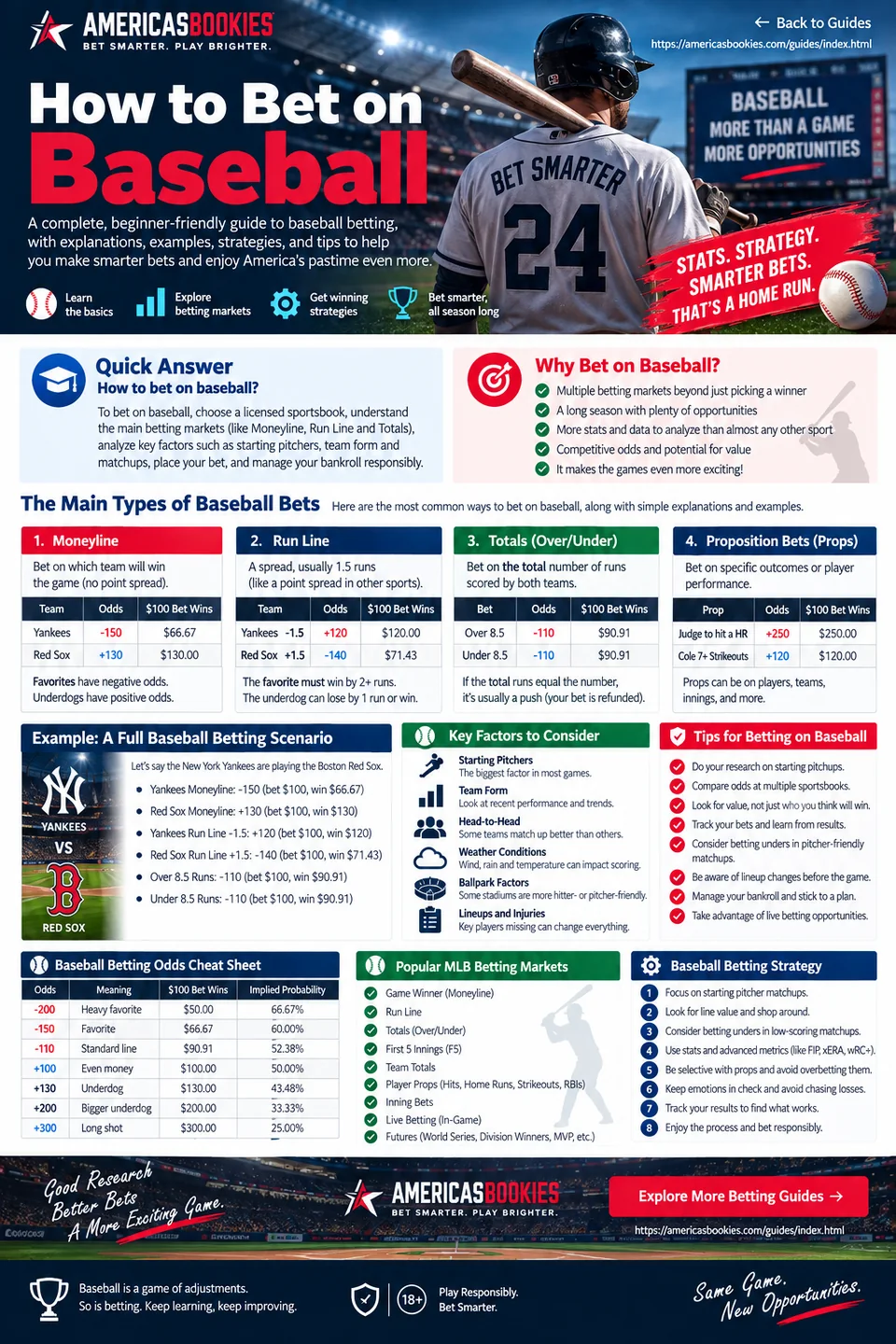
How to read baseball betting odds
U.S. sportsbooks commonly display baseball prices in American odds. Negative odds show how much you would need to risk to make $100 of profit at that exact scale. Positive odds show how much profit a $100 stake would make. You do not have to bet exactly $100 or the number shown; sportsbooks calculate the payout proportionally for your actual stake.
| Odds | Simple meaning | Profit on a $100 stake | Approx. implied probability |
|---|---|---|---|
| -200 | Strong favorite price | $50.00 | 66.7% |
| -150 | Favorite price | $66.67 | 60.0% |
| -110 | Common two-way market price | $90.91 | 52.4% |
| +100 | Even money | $100.00 | 50.0% |
| +150 | Underdog price | $150.00 | 40.0% |
| +200 | Larger underdog price | $200.00 | 33.3% |
Implied probability is a useful translation, but the two sides of a sportsbook market generally add up to more than 100% because the price includes margin. Do not treat the displayed implied probability as a perfect forecast. It is a way to understand the price you are being asked to pay.
How to bet on baseball step by step
- Choose a legal sportsbook available where you are. Make sure you understand age requirements, account verification, deposits, withdrawals, and responsible-gambling tools before betting.
- Open the baseball or MLB section. Find the game, futures market, or player market you want to evaluate.
- Choose the exact bet type. Decide whether your opinion is about the outright winner, run margin, total runs, first five innings, team scoring, or an individual player.
- Compare the odds. Two sportsbooks can post the same selection at different prices. Even small differences can matter over many bets.
- Check game information. Confirm probable starters, lineups when available, bullpen workload, injuries, weather, and any late changes that matter to your market.
- Enter a stake. Use an amount that fits a predetermined entertainment budget and that you can afford to lose.
- Read the bet slip before confirming. Check the selection, odds, stake, potential return, pitcher conditions if shown, and any odds-change prompt.
- Track the result and settlement. Keep records of the market, price, stake, and outcome rather than judging your process only by whether one ticket won.
The mechanics are similar to betting other sports, but the baseball-specific work happens in steps three through five. Our bet slip guide explains what to verify on the confirmation screen before money is committed.
Why starting pitchers matter so much
Starting pitchers influence baseball prices because they can shape several innings of run prevention, strikeout potential, walk rates, batted-ball quality, and bullpen usage. A top starter facing a weak offense can push a moneyline toward the favorite and pull a total downward. A struggling starter or difficult matchup can do the opposite.
But pitcher analysis should go beyond win-loss records or ERA alone. ERA describes runs allowed, but it can be affected by defense, sequencing, and luck on balls in play. Metrics such as strikeout rate, walk rate, fielding-independent pitching measures, expected ERA-style estimates, ground-ball rate, hard contact, pitch velocity, and recent workload can add context. You do not need to become a professional analyst; the point is to avoid reducing a pitcher to one headline number.
Handedness matters too. A lineup full of hitters who perform especially well against left-handed pitching can change how you view a left-handed starter, and the same applies in reverse. Just remember that small samples can be noisy. The sportsbook market already incorporates widely known information, so a statistic is useful only if it changes your estimate enough relative to the price.
Do not ignore the bullpen
A starting pitcher rarely completes every game. Full-game bets therefore depend on relievers, and bullpen quality can be the difference between a good first-five opinion and a good full-game opinion. Before betting, look at which high-leverage relievers have pitched on consecutive days, how many pitches they threw, whether the closer or setup arms are likely available, and how deep the starter is expected to work.
Consider a simple scenario: Team A has the better starting pitcher, but its top three relievers worked heavily the previous night. If your edge is concentrated in the opening five innings, an F5 moneyline might isolate it better than a full-game moneyline. That does not automatically make the F5 bet good; the price still needs to be reasonable. It simply demonstrates how market selection can match your analysis.
Lineups, offense, park factors and weather
Baseball scoring depends on the interaction between hitters, pitchers, defense, park environment, and weather. A team name alone can hide major daily changes. A star hitter may be resting, a catcher with a different defensive profile may start, or a lineup can shift from predominantly right-handed to left-handed depending on the opposing pitcher.
- Lineup quality: check who is actually starting and where key hitters appear in the batting order.
- Platoon splits: some hitters and pitchers perform differently depending on the opponent's handedness.
- Ballpark: dimensions, altitude, foul territory, and environmental characteristics can influence offense.
- Weather: wind direction, temperature, humidity, and rain risk can affect run environment or game status.
- Defense and catching: run prevention is not solely a pitching statistic; fielding and catcher performance can matter.
- Travel and scheduling: day games after night games, long trips, and compressed schedules can influence rest and lineup choices.
The goal is not to find a long checklist that guarantees a winner. It is to identify which inputs matter most to the market you are considering, then compare your view with the price.
Moneyline vs. run line: which should you choose?
A moneyline and run line can express similar beliefs with different risk-and-reward profiles. If you believe a favorite is likely to win but not necessarily by multiple runs, the moneyline may better match your view. If you expect a favorite to win comfortably, accepting -1.5 runs can improve the odds, although it adds a new condition that can turn a one-run victory into a losing ticket.
For an underdog, +1.5 may provide protection against a narrow loss, but the price will usually be more expensive than taking that team on the moneyline. The decision is therefore not "which market pays more?" but "which set of probabilities and prices gives me the better deal?"
| Your view | Market that may fit the view | Tradeoff to understand |
|---|---|---|
| Favorite likely wins a close game | Favorite moneyline | Usually costs a more expensive price. |
| Favorite has a meaningful chance to win by 2+ | Favorite -1.5 run line | Better price, but a one-run win loses. |
| Underdog can keep the game close | Underdog +1.5 | Added cushion usually comes with a worse price. |
| Underdog has a real outright-win chance | Underdog moneyline | No protection if the team loses by one. |
How to think about baseball totals
Totals invite simple narratives—"two good pitchers, take the Under" or "two powerful offenses, take the Over"—but the market is more complicated. A low total can already reflect elite starting pitchers, and a high total can already account for favorable hitting conditions. What matters is whether the posted number and price are too high or too low relative to your estimate.
For an Under, ask what could create unexpected scoring: poor bullpen depth, high walk rates, defensive weakness, strong wind toward the outfield, a small park, or lineups that match up well with the pitchers. For an Over, ask the opposite: are the starters better than their recent ERA suggests? Are key hitters missing? Is the wind suppressing power? Is a strong bullpen fully rested?
Also separate full-game totals from F5 totals. A matchup can support an F5 Under because of two strong starters while still producing a more neutral full-game outlook if both bullpens are vulnerable.
Baseball player props: useful market or distraction?
Player props can be useful when your analysis is specific. A pitcher strikeout prop, for example, can depend on the pitcher's strikeout ability, opponent strikeout tendencies, expected pitch count, umpire zone tendencies where available, and whether the pitcher is likely to work deep enough into the game. A hitter total-bases prop can depend on lineup position, handedness matchup, park, opposing pitcher quality, and expected plate appearances.
The caution is that props are easy to overbet because there are so many of them. Do not confuse selection volume with opportunity. If you have researched only one or two props carefully, there is no requirement to add three more to create action. Limits and market liquidity can also differ from main markets, and the grading rules can be more detailed.
Can you parlay baseball bets?
Yes. Sportsbooks commonly allow parlays that combine multiple baseball selections, and many also offer same-game parlays. The payout rises because every included leg generally must win for the ticket to cash. That higher payout is paired with a lower probability of winning the entire combination.
Baseball correlations also matter. Some same-game combinations are logically connected—for example, a strong pitching performance and a low game total—but sportsbooks may adjust same-game parlay pricing to account for correlation. Never assume multiplying the displayed single-market odds will reproduce the same-game parlay price.
For a detailed explanation of combined odds and probability, see the parlay betting guide.
How live baseball betting works
Live or in-play baseball betting updates as the game develops. Odds can shift after a home run, pitching change, rally, injury, or even a high-leverage plate appearance. Books may offer live moneylines, live run lines, updated totals, inning markets, and next-event props.
Live betting can feel attractive because you are watching new information arrive. The challenge is that the sportsbook is updating too, often faster than a human can analyze every change. Prices can move while your bet slip is open, and broadcast feeds can be delayed relative to the data used by the book. Treat live markets as a faster version of normal pricing, not an automatic informational advantage.
Before using in-play markets, read our live betting guide, which covers latency, price changes, and cash-out mechanics.
Why line shopping matters in baseball
Line shopping means checking more than one sportsbook for the same market. One book might offer a favorite at -145 while another lists -155. An underdog might be +135 at one book and +145 at another. A total can be 8.5 everywhere but priced differently on the Over and Under.
The difference can look small on one ticket, but repeated price improvements can compound over a large sample. If your entire baseball process focuses on handicapping while automatically accepting the first available odds, you are ignoring one of the few parts of betting that can be improved without predicting the game more accurately.
Compare like with like. A -150 full-game moneyline is not directly comparable to a -145 market that has different pitcher conditions or settlement rules. Make sure the underlying bet is the same before choosing the better price.
Baseball settlement rules you should check
Baseball markets can have more rule details than a beginner expects. Before betting, look at how the sportsbook handles:
- Starting pitcher changes: some markets or books may use action rules while others can attach conditions to named starters.
- Postponed, suspended, or shortened games: full-game and prop markets may require different innings or official-status conditions.
- Extra innings: many full-game markets include them, but limited-inning markets obviously do not.
- First-five ties: a two-way F5 moneyline can settle differently from a three-way market that includes a tie option.
- Player participation: props may require a plate appearance, start, pitch thrown, or another threshold to have action.
- Stat corrections: books usually define which official league statistics and timing are used for grading.
Do not assume another sportsbook's rule applies. The same market name can have slightly different grading language, especially for player props and weather-affected games.
Baseball betting strategy: focus on process, not predictions
No baseball strategy can guarantee profits. A useful approach is to make your process repeatable enough that you can tell why you placed a bet and whether the price matched your estimate. That means separating handicapping, price evaluation, and stake sizing instead of blending them into one feeling about a team.
- Build a fair-price estimate. Decide what probability you assign to the outcome before being influenced by the payout.
- Compare the market price. A bet is only interesting when your estimate differs enough from the sportsbook price to justify uncertainty and margin.
- Use the right market. If your edge is mostly starting pitching, consider whether F5 expresses it better than full game.
- Shop the line. Take the better available price when the market and rules are otherwise identical.
- Keep records. Track market, price, closing price where possible, stake, result, and notes so you can evaluate decisions over time.
- Stay selective. A full baseball schedule does not mean you need a bet on every game.
Strategy should help you make fewer impulsive decisions, not justify larger or more frequent wagers.
Bankroll and stake sizing for baseball
Baseball's daily schedule can create the feeling that there is always another opportunity. That makes bankroll rules especially useful. Decide in advance how much money is available for betting entertainment, separate it from essential expenses, and set a normal stake size that prevents one game from having an outsized financial effect.
Some bettors use a flat amount on most plays; others define a "unit" as a small portion of their bankroll. The exact percentage is personal, but the principle is straightforward: a normal loss should not create pressure to chase with a much larger next bet. If a losing streak would force you to deposit money you need elsewhere, the stakes are too large.
For more on units, limits, and drawdowns, read the bankroll management guide and our guide to what stake means in betting.
Common mistakes when betting on baseball
- Betting only the better team. A good team can still be a poor wager at an expensive price.
- Ignoring the starting pitcher or assuming the starter decides everything. Full-game markets also depend on bullpens, offense, defense, park and price.
- Using season-long averages without today's lineup. The actual players in the game matter more than a generic team label.
- Forgetting bullpen fatigue. Relief availability changes from day to day.
- Treating a run line like a football spread. Baseball's common 1.5-run margin makes one-run games especially important.
- Assuming F5 rules are identical everywhere. Check whether ties push or whether the market has a separate tie selection.
- Chasing a losing game with live bets. A changing score does not create an obligation to recover an earlier stake.
- Overloading on props and parlays. More selections do not automatically mean more value.
- Not comparing odds. Accepting a worse price repeatedly can reduce long-run results even when your picks are unchanged.
Responsible baseball betting
Baseball's long season and frequent games can make betting feel continuous. Keep it entertainment rather than a financial obligation. Set deposit, time, and stake limits before a session; do not use money needed for bills or savings; and never increase your bets because you feel you are "due" after losses.
Skip games when you do not have a clear reason for the wager, use limits that fit your budget, and take a break if betting becomes stressful or difficult to control. See the responsible gambling guide for practical limit-setting tools and support options.
Baseball betting terminology cheat sheet
| Term | Plain-English meaning |
|---|---|
| Moneyline | A bet on which team wins the game. |
| Run line | Baseball's spread, commonly +1.5 or -1.5 runs. |
| Total | A bet on whether combined runs finish over or under a posted number. |
| F5 | A market settled using only the first five innings. |
| Team total | Over/under on the runs scored by one team. |
| Player prop | A wager on an individual player's statistical outcome. |
| Listed pitcher | A condition, where offered, tying action to named starting-pitcher participation under the book's rules. |
| Action | A bet that remains active under the sportsbook's stated rules even if certain pregame details change. |
| Push | A tie against the betting line, typically resulting in the stake being returned. |
| Price | Another way to refer to the odds attached to a betting selection. |
Frequently asked questions about betting on baseball
How do you bet on baseball?
Choose a legal sportsbook, open the baseball section, select a game and market, compare the odds, enter a stake you can afford to lose, and review the bet slip before confirming. Common choices include the moneyline, run line, game total, first-five innings, team totals, and player props.
What is the easiest baseball bet for beginners?
The moneyline is often the simplest because the basic question is only which team wins. The price still matters: a favorite at -200 requires a much higher break-even win rate than an underdog at +150, so a simple market is not the same as a simple decision.
What does -1.5 mean in baseball betting?
A team at -1.5 must win by two or more runs to cover the run line. A team at +1.5 can win outright or lose by one run and still cover. The odds attached to each side determine the potential payout.
What does over 8.5 mean in baseball?
Over 8.5 wins if both teams combine for at least nine runs. Under 8.5 wins with eight or fewer combined runs. Because the line includes a half-run, the game cannot push by landing exactly on 8.5.
What is a first-five-innings bet?
An F5 bet is graded using the score or statistics from only the first five innings. It can reduce the influence of later bullpen innings and put more emphasis on the starting pitchers. Tie rules differ depending on whether the market is two-way or three-way.
Do starting pitchers matter when betting baseball?
Yes, especially for moneylines, totals, and first-five markets. But starting pitchers are not the entire game. Bullpen availability, lineups, defense, park environment, weather, and the offered odds also affect the wager.
Do extra innings count in baseball bets?
They count in many full-game markets, but not in first-five or other limited-inning markets. Sportsbooks can also have specific rules for suspended or shortened games. Read the exact market rules rather than assuming all bets are settled the same way.
What should I check before placing a baseball bet?
Check the market and win condition, current odds, stake and potential return, probable starters, lineup news, bullpen availability, weather, and any settlement rules tied to pitchers or game length. If you use multiple sportsbooks, compare the same market for a better price before confirming.
Keep learning
Baseball becomes easier to bet when every market has a clear win condition.
Continue with odds, moneylines, bet types, bankroll basics, live betting, and sport-specific explanations in the complete America's Bookies betting guides library.