Home / Guides / What Does Stake Mean in Betting?
Betting basics
What does stake mean in betting?
Your stake is the amount of money you put at risk on a bet. It is not the same as your profit or total return, and understanding that distinction makes betting slips, odds, bonus rules, and bankroll decisions much easier to read.

What is a stake in betting?
In sports betting, the stake is the amount of money you place on a particular bet. It is the part of your balance that becomes committed when the sportsbook accepts the wager. A $5 stake means $5 is at risk. A $100 stake means $100 is at risk. The size of the stake does not tell you whether the bet is likely to win; it only tells you how much money has been attached to that prediction.
The term is common across sportsbooks, horse racing, exchanges, casino-style wagering, and betting conversations. Some apps label the field stake, while others use bet amount, wager amount, or risk. In ordinary sportsbook use, those labels often point to the same practical question: how much money are you committing to this ticket?
Stake is one of the core pieces of a betting transaction because odds alone do not determine the dollars you can win. The odds provide the price; the stake supplies the amount to which that price is applied. Two people can take exactly the same team at exactly the same odds but have very different potential profits because one stakes $10 and the other stakes $100.
That is also why a bigger stake does not make a selection better. Increasing a stake magnifies the financial result in either direction. A winning bet produces more dollars of profit, but a losing bet also costs more. Stake size changes exposure, not the underlying probability of the event.
It is the amount committed to the wager, not the amount you hope to receive back.
The same odds create different dollar profits when the stake changes.
A settled winning cash bet generally returns the original stake plus profit.
Bonus-bet rules can exclude the stake itself from the winning return.
Stake vs. wager, bet amount, profit, winnings and total return
Betting language becomes confusing because several terms appear next to the same dollar figures. The easiest way to separate them is to treat the stake as the input. You choose the stake before submitting the bet. The odds then determine the potential profit, and the settlement determines what is ultimately returned.
| Term | What it usually means | $50 stake at +150 example |
|---|---|---|
| Stake | The money committed and at risk. | $50 |
| Bet amount / wager amount | Often another label for the stake field. | $50 |
| Wager | The bet itself; in some interfaces it can also mean the amount wagered. | A $50 moneyline wager |
| Profit / net winnings | Money won above the returned cash stake. | $75 |
| Total return | The amount credited back after a win, normally stake plus profit. | $125 |
| Potential payout | Often total return, but sportsbook wording varies, so check the slip. | Often $125 |
For more on the broader term, see our guide to what wager means in betting. The important distinction is that wager can describe the entire bet, while stake is specifically the amount of money committed to it.
A simple stake, profit and return example
Suppose you place a $50 stake at +150 American odds. Positive odds of +150 mean a $100 stake would make $150 in profit. Because your stake is half of $100, the potential profit is half of $150, or $75.
If the bet wins, the standard cash settlement is $125 total: your $50 stake comes back and $75 is added as profit. If the bet loses, the stake is lost and there is no winning return. This single example explains why saying “I won $125” can be ambiguous: the bettor may mean $125 was returned, even though only $75 was profit.
Stake examples at different odds
The table below shows how changing the odds or the stake changes the potential profit. These examples use American odds and assume ordinary cash bets where the original stake is returned after a win.
| Stake | Odds | Potential profit | Total return if won | Amount lost if lost |
|---|---|---|---|---|
| $10 | +100 | $10.00 | $20.00 | $10.00 |
| $25 | +150 | $37.50 | $62.50 | $25.00 |
| $50 | -110 | $45.45 | $95.45 | $50.00 |
| $100 | +200 | $200.00 | $300.00 | $100.00 |
| $150 | -150 | $100.00 | $250.00 | $150.00 |
| $250 | -200 | $125.00 | $375.00 | $250.00 |
Notice that the stake is never the profit. At -200, a $250 stake makes only $125 of profit because the selection is priced as a relatively strong favorite. At +200, a $100 stake makes $200 of profit because the underdog price pays two dollars of profit for each dollar staked. The amount you risk and the amount you can win are related, but they are not interchangeable.
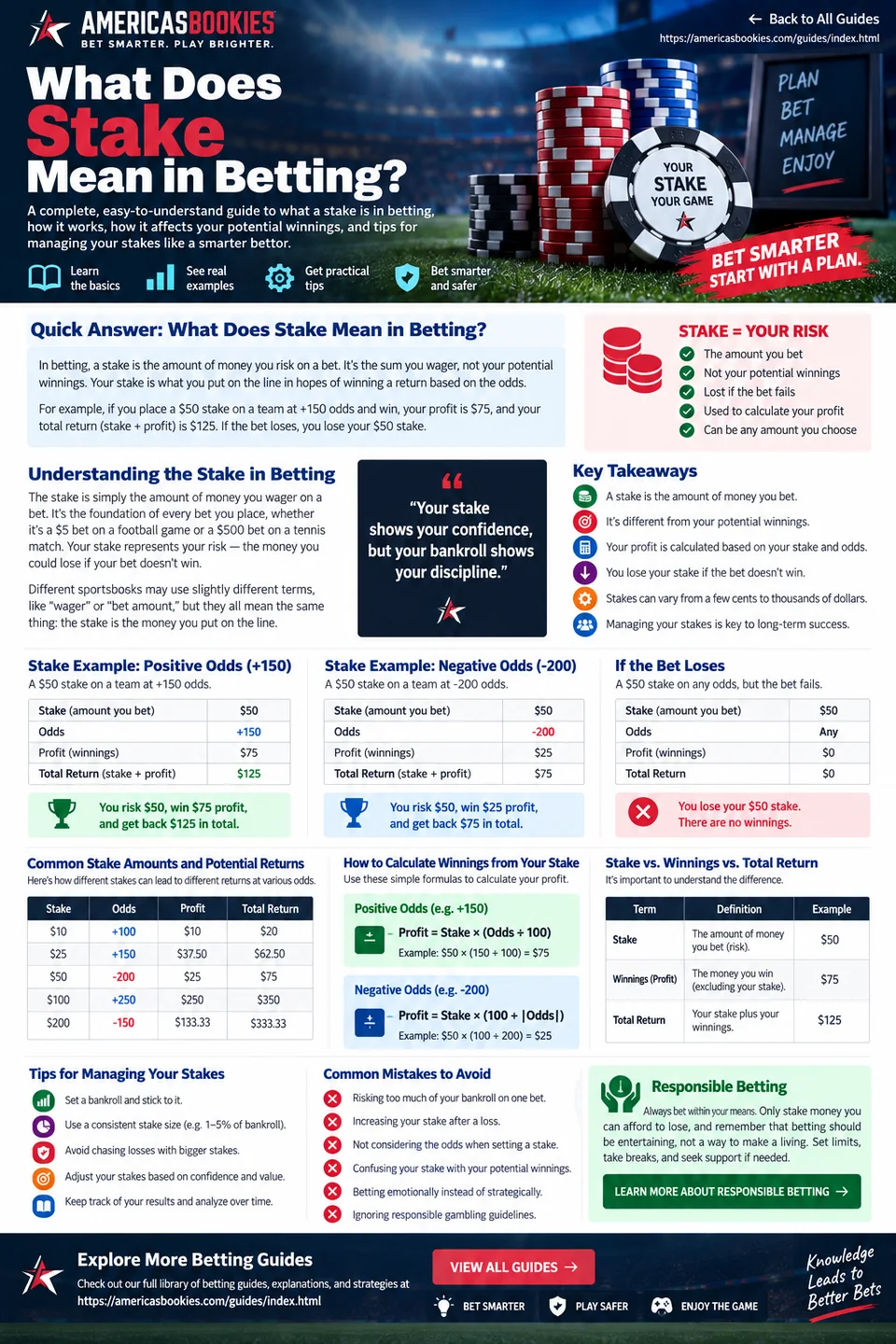
How does your stake affect betting payouts?
Your stake scales the dollar result of a bet. If the odds stay the same, doubling the stake doubles both the potential profit and the amount you stand to lose. Cutting the stake in half cuts both in half. The sportsbook does not make a bet more likely to win because you entered a larger number in the stake box.
Positive American odds
For positive odds, the potential profit can be calculated as:
Profit = Stake × (positive odds ÷ 100)
At +150, a $20 stake produces $30 of potential profit; a $50 stake produces $75; a $200 stake produces $300. Add the original cash stake to the profit to get the total return.
Negative American odds
For negative odds, use the absolute value of the price:
Profit = Stake × (100 ÷ absolute value of negative odds)
At -200, a $20 stake produces $10 of potential profit; a $50 stake produces $25; a $200 stake produces $100. Again, the winning cash return usually includes the original stake plus that profit.
Decimal odds
Decimal odds make the stake relationship especially direct because the displayed number normally represents the total return multiplier:
Total return = Stake × Decimal odds
For example, a $40 stake at decimal odds of 2.50 would return $100 if it wins. The profit is $60 because $40 of the $100 is the returned stake. Our odds and lines guide explains American, decimal, and fractional formats in more detail.
Same odds, different stake
| Stake at +150 | Potential profit | Total return |
|---|---|---|
| $10 | $15 | $25 |
| $25 | $37.50 | $62.50 |
| $50 | $75 | $125 |
| $100 | $150 | $250 |
| $250 | $375 | $625 |
This scaling effect is useful to understand when a betting app displays “to win” or “potential return” instantly as you change the stake field. The odds may remain unchanged, while the dollar figures update because they are being recalculated from the amount you typed.
What does total stake mean?
Total stake usually means the full amount of money committed, but the exact calculation depends on the bet structure. On a simple single bet, the total stake is normally obvious: enter $40 and the total stake is $40. On a slip with several independent singles, the sportsbook may show the sum of all individual stakes.
Combination bets can make the label more important. Imagine a round-robin or system bet that creates six separate combinations and applies a $5 stake to each combination. The total stake would be $30, not $5, because six individual $5 wagers are being submitted. A bettor who looks only at the per-line amount can underestimate the money at risk.
The same principle applies to “each way” betting in markets where an each-way selection is actually two bets: one on the win and one on the place. A quoted $10 each-way stake may represent $20 total outlay. Because interface conventions vary, check whether the number beside stake is per line, per combination, per leg, or the final combined amount.
How stake works in singles, parlays and other bet types
The definition of stake stays consistent, but the way one stake is applied can change with the bet type.
- Single bet: one stake is tied to one selection or market. A $25 stake on a moneyline means $25 is at risk on that outcome.
- Parlay: one stake is normally attached to the entire combined ticket. If a $20 four-leg parlay loses because one leg fails, the $20 parlay stake is lost under standard rules.
- Round robin or system bet: the slip can create multiple smaller bets. The displayed total stake may be the per-combination stake multiplied by the number of combinations.
- Live bet: the stake still means the amount risked, but the odds can change quickly while the ticket is being prepared. Always review the accepted price and stake together.
- Futures bet: the stake can remain tied up until a season, tournament, award, or long-range event is settled.
- Bonus bet: the promotional stake may not be returned after a win. Only the resulting profit may be credited as withdrawable cash, depending on the offer terms.
If you are comparing structures, our types of sports bets guide covers singles, spreads, totals, props, futures, parlays and more.
Common staking approaches: flat stakes, units, percentages and variable stakes
“Stake” describes the dollar amount on one bet. “Staking” or “stake sizing” describes the approach used to choose that amount. There is no single required method, and a staking system does not turn uncertain bets into guaranteed profits. Its main purpose is usually to control how much of a budget is exposed from one wager to the next.
| Approach | How it works | Main advantage | Main caution |
|---|---|---|---|
| Flat stake | Bet the same cash amount on each wager. | Simple and easy to track. | The same dollar amount can become too large if the bankroll falls. |
| Unit staking | Define a standard “1 unit” amount and express bets in units. | Makes records comparable without focusing on raw dollars. | Calling a bet “3 units” does not make the prediction three times better. |
| Percentage staking | Stake a fixed percentage of a current bankroll. | Automatically scales exposure up or down. | Frequent recalculation can encourage over-management. |
| Variable / confidence staking | Change the stake based on perceived edge or confidence. | Allows differentiated exposure. | Subjective confidence can be poorly calibrated and encourage oversized bets. |
A common educational convention is to define one unit as a small, pre-set fraction of a dedicated betting bankroll, but that is not a universal rule or a promise of safety. The right amount is the amount that fits within money you can afford to lose. If staking becomes a source of stress, the better response is to reduce or stop betting, not to search for a more aggressive formula.
What is a unit stake?
A unit is a standardized stake size chosen by the bettor. It is useful because it separates analysis from personal account size. Someone might define 1 unit as $10, while another person defines 1 unit as $25. If both report a 2-unit bet, the cash amounts differ, but the relative size inside each person's plan is the same.
For example, if 1 unit equals $20:
- 0.5 units = $10 stake
- 1 unit = $20 stake
- 1.5 units = $30 stake
- 2 units = $40 stake
Units are especially useful for record keeping, but they should not be treated as a ranking system where more units automatically mean “more certain.” Every sports bet can lose. A unit framework is simply a way to express and control stake size consistently.
Stake terms you may see on a betting slip
Sportsbooks use slightly different labels, and promotions introduce extra language. Knowing the common phrases can prevent a mistake at the confirmation screen.
- Stake / bet amount: the money being committed to the ticket.
- Risk: another way to show the stake, especially in a “risk X to win Y” display.
- To win: usually the potential profit, not the total return. Check the slip because sportsbook interfaces can vary.
- Potential return: usually the original cash stake plus potential profit.
- Total stake: the combined amount committed across all lines or combinations on the ticket.
- Minimum stake: the smallest amount the sportsbook currently allows on that market or bet type.
- Maximum stake: the largest amount the sportsbook will accept for that ticket under current limits.
- Stake not returned: a common bonus-bet rule meaning the promotional stake itself is excluded from the winning settlement.
Before submitting a ticket, the safest habit is to read the slip field by field. Our guide to reading a betting slip explains selection, odds, stake, potential return, market details, and price-change prompts.
What does “stake not returned” mean?
This phrase matters most in sportsbook promotions. Suppose a sportsbook gives you a $20 bonus bet and the terms say the bonus stake is not returned. You use it at +200 and the bet wins. The +200 price creates $40 in profit on a $20 stake, but because the $20 promotional stake is not returned, you may receive only the $40 profit rather than $60 total.
That is different from a normal $20 cash bet at +200. If the cash bet wins, the standard return is $60: $20 of original cash stake plus $40 profit. Promotional rules can also affect expiration, eligible markets, minimum odds, and withdrawal conditions, so the headline bonus amount never tells the whole story.
Minimum and maximum stakes
Sportsbooks usually apply minimum and maximum limits. A minimum stake might be a very small amount, such as $0.10, $0.50 or $1, while maximums vary much more widely. The accepted maximum can depend on the market, sport, time before the event, account, promotion, and how much risk the sportsbook is willing to take at that price.
A popular major-league moneyline may accept a larger stake than a niche player prop because the market has more liquidity and information. Limits can also shrink when a line is moving or when a sportsbook is less confident in the price. Promotional bets may have a separate “max qualifying stake,” which limits how much of a cash wager counts toward the offer even if the sportsbook would accept more on the underlying market.
Do not assume that “maximum allowed” means “recommended.” A sportsbook limit is an operational ceiling, not personal stake-sizing advice.
How much should you stake on a bet?
There is no universal dollar amount that is appropriate for every bettor. A stake should come from a pre-set entertainment budget, not from rent, bills, emergency savings, borrowed money, or money needed for other priorities. The relevant question is not “How much can this bet pay?” but “How much can I lose without affecting my finances or changing how I feel about the next decision?”
Many bettors use a unit system to avoid making each stake from scratch. For illustration, someone might define one unit as a small percentage of a separate betting bankroll and keep most bets near one unit. The exact percentage is a personal risk decision, not a guarantee or a recommended formula. What matters is that the number is set before the emotional pressure of a win, loss, rivalry, or live game.
Our bankroll management guide goes deeper into units, drawdowns, record keeping, and why chasing losses with larger stakes can rapidly increase risk.
Five questions to ask before entering a stake
- 1Can I afford to lose the full amount?
Treat the stake as money that may not come back. If losing it would affect necessary spending, the stake is too high.
- 2Does the amount fit my pre-set plan?
A budget or unit framework is most useful when it is decided before seeing a tempting payout or feeling pressure to recover a previous loss.
- 3Am I looking at profit or total return?
Make sure the large number on the ticket is not simply the returned stake plus winnings. The distinction matters when comparing bets.
- 4Is the stake applied once or multiple times?
Round robins, systems, and each-way formats can multiply a per-line amount into a larger total stake.
- 5Have I checked the final ticket?
Confirm the selection, odds, stake, total risk, potential return and any promotional conditions before submitting.
Why changing your stake after a loss can be risky
One of the most common staking mistakes is increasing the next bet simply to recover a previous loss. This is often called chasing losses. The problem is mathematical and emotional: a larger stake raises the amount at risk at the exact moment the decision may be influenced by frustration rather than analysis.
Loss-chasing systems can escalate quickly. If a bettor doubles the stake after every loss, a sequence that begins at $10 becomes $20, $40, $80, $160 and $320 after five consecutive losses. The required bankroll grows much faster than the original bet size suggests, and sportsbook limits or available funds can prevent the theoretical recovery bet from ever being placed.
A consistent, pre-defined approach does not eliminate losing streaks, but it can keep one streak from turning into an unexpectedly large financial event. If you feel an urge to increase stakes because you “need” to get money back, that is a useful signal to stop rather than increase the bet.
Common stake mistakes to avoid
- Confusing stake with potential profit. A $100 stake at -200 does not mean $100 profit; it makes $50 of potential profit.
- Calling total return “winnings” without separating the stake. A $250 return on a $100 stake at +150 contains $150 profit, not $250 profit.
- Entering a stake because the payout looks exciting. Bigger numbers on the return field do not make a bet more likely to win.
- Ignoring total stake on combination bets. A $5 per-line amount can become much larger when many combinations are created.
- Assuming bonus-bet stakes come back. Many promotional bets use stake-not-returned rules.
- Betting the sportsbook maximum because it is available. A platform limit is not a personal risk recommendation.
- Increasing stakes after losses. Chasing can accelerate drawdowns and turn emotional decisions into larger financial exposure.
- Changing stake size without tracking results. Records become difficult to interpret when bet sizes move randomly from one ticket to the next.
Responsible staking and bankroll control
Understanding the word stake is useful because it puts the risk in plain view. Before the odds, teams, statistics, or potential payout, there is a simpler number: the amount of money that can be lost. Treating that number as a deliberate choice can make betting easier to control.
Set limits before betting, avoid using money needed for essential expenses, and do not increase a stake to chase a loss. If betting no longer feels like entertainment, take a break and use the deposit limits, wager limits, time-outs, self-exclusion options, or support resources available to you.
Use a fixed entertainment budget, avoid chasing, and stop when betting becomes difficult to control. See the responsible gambling guide for limit-setting tools and support options.
Betting stake terminology cheat sheet
| Term | Plain-English meaning |
|---|---|
| Stake | The amount of money committed to and at risk on a bet. |
| Bet amount | A common sportsbook label for the stake. |
| Unit | A bettor-defined standard stake size used for consistency and record keeping. |
| Total stake | The complete amount at risk across all bets or combinations on the ticket. |
| Profit | The amount won above the returned cash stake. |
| Total return | Usually the returned cash stake plus profit after a winning settlement. |
| To win | Usually the potential profit figure shown on a bet slip. |
| Stake not returned | A promotion rule where the bonus stake itself is excluded from the winning return. |
| Min / max stake | The smallest or largest amount the sportsbook currently allows on the ticket. |
| Flat staking | Using the same cash stake amount on each bet. |
Frequently asked questions about betting stakes
What does stake mean in betting?
A stake is the amount of money you put at risk on a wager. If you enter $25 in the stake field, $25 is committed to that bet. A normal winning cash bet generally returns the $25 plus profit; a losing bet generally loses the $25.
Is stake the same as bet amount?
Usually, yes. Sportsbooks often use “stake,” “bet amount,” “wager amount,” and “risk” for the money being committed. The word “wager” can also mean the bet itself, so stake is the more precise term for the dollar amount at risk.
What is the difference between stake and payout?
The stake is the amount risked before the bet is settled. Payout or total return usually refers to the amount credited back after a winning bet, commonly the original cash stake plus profit. Because sportsbooks can label payout fields differently, check whether the displayed figure includes the stake.
Do you get your stake back if you win a bet?
With a normal cash wager, the original stake is generally returned along with the profit. A $50 cash stake at +100 would normally return $100 after a win: the $50 stake plus $50 profit. Promotional bonus bets can use different settlement rules.
What does total stake mean?
Total stake is the full amount of money committed. On a single bet it may be identical to the stake field. On round robins, systems, multiple singles, or other combination bets, the total stake can be the sum of several individual stakes.
What is a unit stake in sports betting?
A unit is a standard amount a bettor chooses for tracking and stake sizing. If one unit is $20, then a 0.5-unit bet is $10 and a 2-unit bet is $40. A unit is a bookkeeping tool, not a guarantee about the quality of a selection.
What does stake not returned mean?
It means the promotional stake is not added back after a win. For example, if a $20 bonus bet at +200 wins under a stake-not-returned rule, the sportsbook may credit the $40 profit but not the original $20 bonus stake. Always read the promotion terms.
Can a sportsbook limit my stake?
Yes. Minimum and maximum stake limits can vary by event, market, account, promotion, bet type, timing, and sportsbook risk controls. The maximum a book will accept is not a recommended personal stake size.
Keep learning
Once stake makes sense, the rest of the bet slip becomes easier to read.
Continue with wagers, odds, moneylines, bet types, bet slips and bankroll basics in the complete America's Bookies betting guides library.