Home / Guides / What Is Liability in Betting?
Betting risk explained
What is liability in betting?
Liability is the amount of money that could be lost or owed if a betting outcome goes against you. For most fixed-odds bettors it is usually the stake at risk, but sportsbook exposure and betting-exchange lay liability work differently.
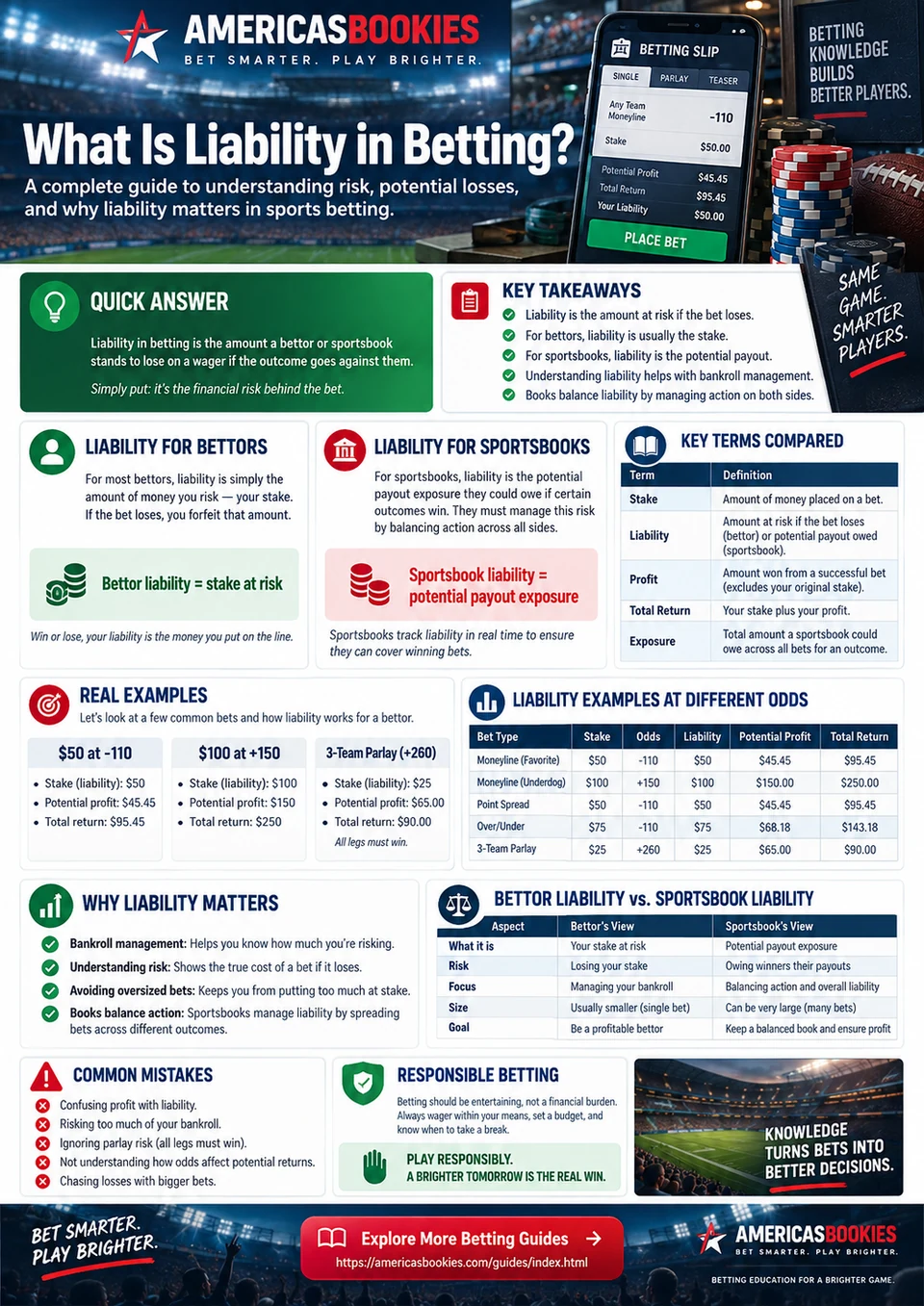
What does liability mean in betting?
The easiest way to understand liability is to ask one question: what is the most this position can cost if the unfavorable outcome happens? That amount is the liability. It is the downside attached to a wager before settlement.
For a recreational bettor using a conventional fixed-odds sportsbook, the answer is usually simple. If you place a $25 cash bet and the ticket either wins or loses, the $25 is your maximum loss. In that ordinary case, bettor liability and stake are the same dollar amount. That is why betting apps often do not show a separate “liability” field for standard sportsbook bets: the risk is already visible in the stake box.
But the term becomes more important when the structure changes. A bookmaker can face thousands or millions of dollars of payout exposure across many customers. A betting-exchange user who lays a selection is taking the other side of another bettor's wager and can risk more than the lay stake. A trader may also talk about the total liability across several open wagers rather than one ticket at a time.
So “liability” is not a special type of bet. It is a risk measurement. The exact calculation depends on who is carrying the risk and how the bet is structured.
Three common meanings of liability
| Context | What liability means | Simple example |
|---|---|---|
| Fixed-odds bettor | Maximum cash loss if the bet loses; usually the stake. | Stake $50 → liability usually $50. |
| Sportsbook | Payout exposure if a customer or group of customers wins. | A $100 bet at +300 can require a $400 total return. |
| Exchange lay bettor | Amount owed if the selection being laid actually wins. | Lay $50 at 3.00 → liability $100. |
The same word therefore describes different sides of the transaction. The common thread is always financial exposure.
Liability vs. stake vs. profit vs. total return
These four terms are easy to blur together because they appear on the same betting slip, but they answer different questions. The stake tells you what you put into the bet. Liability tells you what you can lose. Profit tells you how much you gain above your returned cash stake if the bet wins. Total return is normally the stake plus profit on a standard winning cash wager.
| Term | Question it answers | $100 bet at -110 |
|---|---|---|
| Stake | How much money did I put on the bet? | $100.00 |
| Liability | How much can I lose if it fails? | Usually $100.00 |
| Potential profit | How much do I make above my stake if it wins? | $90.91 |
| Total return | How much comes back after a win? | $190.91 |
That distinction matters because the biggest number on the screen is not necessarily the biggest risk. If a sportsbook displays a $190.91 return on a $100 bet, the bettor is not risking $190.91. The bettor is risking the $100 stake. The other $90.91 is potential profit that exists only if the wager wins.
For a fuller explanation of the risk amount itself, see what stake means in betting. If the price is the confusing part, our odds and lines guide explains how American, decimal, and fractional odds turn a stake into a potential return.
Is liability always equal to the stake?
No. It is equal to the stake in the most common fixed-odds cash-bet scenario, but that shortcut stops working in other structures. Exchange lay bets are the clearest example: the bettor can accept a $50 lay stake while carrying $100, $150, or more of liability depending on the odds. A sportsbook's liability can also be far larger than the customer's stake because the book may owe the customer both profit and returned stake, while its net exposure also depends on all other action in that market.
Betting liability examples at different odds
For ordinary fixed-odds sportsbook bets, changing the odds changes the potential profit and return, but it does not normally change the bettor's maximum loss when the stake stays the same. If you risk $100, the fixed-odds liability is generally $100 whether the selection is -200, -110, +150, or +400.
| Bet | Stake | Odds | Bettor liability | Potential profit | Total return if won |
|---|---|---|---|---|---|
| Favorite moneyline | $100 | -200 | $100 | $50.00 | $150.00 |
| Point spread | $100 | -110 | $100 | $90.91 | $190.91 |
| Total | $75 | -110 | $75 | $68.18 | $143.18 |
| Underdog moneyline | $100 | +150 | $100 | $150.00 | $250.00 |
| Three-leg parlay | $25 | +600 | $25 | $150.00 | $175.00 |
Notice how a small parlay stake can create a large payout while the bettor's fixed-odds liability remains the amount staked. That does not mean the bet is “low risk” in probability terms. It means only that the dollar loss is capped at the stake. A +600 parlay usually has a lower implied chance of winning than a short-priced favorite, even though the dollar liability may be smaller.
What happens on a push, void, or canceled market?
If a standard cash wager is settled as a push or void under the sportsbook's rules, the stake is usually returned and the final realized loss is zero. Before settlement, however, the money is still tied to the open wager and may be unavailable for other bets. Liability describes what can be lost under the current position; settlement rules determine what ultimately happens to the funds.
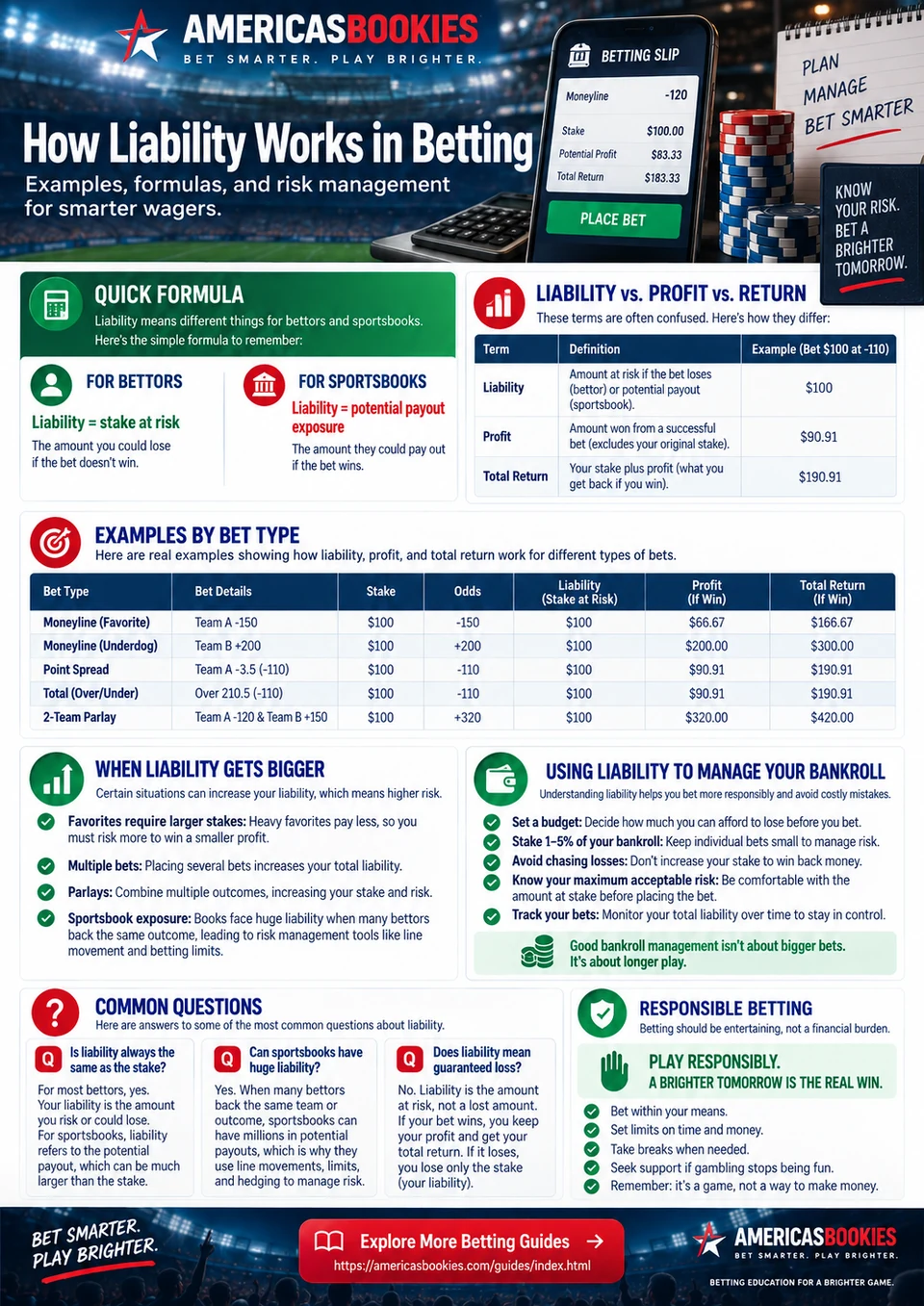
What is sportsbook liability?
When bookmakers use the word liability, they are usually talking about the amount the business stands to lose or pay out if a particular event, selection, or combination of outcomes wins. This is why liability matters to sportsbook trading teams even when the customer sees only a simple bet slip.
Suppose a bettor stakes $100 at +300. If the selection wins, the standard total return is $400: $300 of profit plus the returned $100 stake. At a very simple single-ticket level, the sportsbook knows that accepting the wager creates a $400 payout obligation if that outcome hits. But a real sportsbook does not evaluate that bet in isolation. It may already have thousands of dollars of stakes on the opposite side, other correlated markets, promotional credits, parlays containing the same team, and live positions that change every minute.
For that reason, industry conversations can use gross liability and net liability differently. Gross liability focuses on what might have to be paid to winners. Net exposure considers money already taken on losing outcomes and other offsets. The exact internal risk model is more complicated than a single customer payout.
Why sportsbooks care about liability
- Market limits: a book may reduce the maximum stake it will accept when additional action would create too much exposure.
- Price movement: odds can move partly because the market is changing and partly because a trading team wants to attract or discourage certain action.
- Parlay concentration: many parlays sharing the same popular leg can create a large correlated payout if that leg wins.
- Futures markets: championship or award bets can stay open for months, creating long-duration exposure that changes as the season develops.
- Live betting: liability can shift quickly as game state, prices, and customer positions update in real time.
- Promotions: bonuses, odds boosts, insurance offers, and profit boosts can change the operator's economics even when the public odds look familiar.
Sportsbooks do not need perfectly equal action on every side to operate. Their goal is to price markets, manage risk, and control overall exposure within their own trading rules. “The book always wants exactly 50/50 action” is an oversimplification.
What is lay bet liability on a betting exchange?
Betting exchanges make the concept of liability much more visible because users can either back an outcome or lay it. A back bet is similar to a normal sportsbook bet: you are betting that the selection will happen. A lay bet means you are betting that the selection will not happen, effectively taking the bookmaker side of another user's wager.
When you lay a selection, the amount shown as the lay stake is generally what the other bettor stands to win from you if your lay is successful from their perspective. Your own maximum loss can therefore be larger than that stake.
A common formula is:
Lay liability = lay stake × (decimal odds − 1)
So if you lay a team for $50 at decimal odds of 3.00, your liability is $50 × (3.00 − 1) = $100. If the team you laid wins, you lose $100. If it does not win under the market's settlement rules, you receive the other side's stake, subject to exchange commission and any platform-specific rules.
| Lay stake | Decimal odds | Lay liability | Why |
|---|---|---|---|
| $50 | 1.50 | $25 | $50 × 0.50 |
| $50 | 2.00 | $50 | $50 × 1.00 |
| $50 | 3.00 | $100 | $50 × 2.00 |
| $50 | 5.00 | $200 | $50 × 4.00 |
| $50 | 10.00 | $450 | $50 × 9.00 |
This table shows why “liability equals stake” is not a universal rule. At longer lay odds, the downside can become much larger than the stake figure. Exchange interfaces normally show the required liability before confirmation for exactly this reason. Commission and market rules differ by exchange, so the simple examples above focus only on the core liability calculation.
How liability works in parlays and same-game parlays
For the bettor, a standard cash parlay normally has one stake and one maximum loss: the amount staked on the ticket. A $20 five-leg parlay usually carries $20 of bettor liability. If any required leg loses, the parlay loses and the $20 is gone, subject to void-leg and settlement rules.
The sportsbook side can be very different. A $20 parlay at +2000 would return $420 if it wins. One ticket may not matter much to a large book, but thousands of customers can build parlays around the same heavily promoted team, quarterback prop, or primetime result. When many tickets share the same outcome, the book's potential payout exposure can become highly concentrated.
Same-game parlays add another layer because the legs can be related. A quarterback passing-yard over and a receiver receiving-yard over, for example, may be positively correlated. Sportsbooks account for correlation when pricing eligible combinations because simply multiplying independent single-leg odds can misstate the true joint probability and therefore the liability.
To understand how parlay prices are assembled, read our parlay betting guide. The bettor's cash liability may still be only the stake, but the probability, payout, and sportsbook exposure can change dramatically as legs are added.
How liability works with live betting and cash out
Live markets make liability more dynamic because prices move as the game changes. If you have a $100 live moneyline bet open, your fixed-odds bettor liability is generally still the $100 stake. The app may then offer a cash-out amount that lets you settle early for a gain or loss before the final result.
A cash-out offer does not erase the concept of liability until the cash-out is actually accepted and settled. Before acceptance, the original ticket remains open. After acceptance, the open position is replaced by the realized cash-out result under the sportsbook's terms. The exact amount can change rapidly or disappear, especially around important plays.
Live betting can also create portfolio liability when several bets are open at once. A bettor might have a pregame spread, an in-play total, and a player prop on the same event. Looking at each stake separately can make the total risk feel smaller than it is. Add the maximum possible loss across all open positions to understand the amount of bankroll exposed.
Liability with bonus bets, free bets, and promotional credits
Promotional bets can make the word liability less intuitive because the promotional stake may not be cash that can be withdrawn. If a sportsbook gives you a $25 bonus bet with stake not returned terms, losing it may reduce the promotional balance by $25 but may not reduce your deposited cash by $25. If it wins at +200, the book may credit $50 in profit rather than a $75 total return.
From a practical bankroll perspective, separate cash liability from promotional value at risk. A bonus credit still has value, but it is not always equivalent to cash because it can have eligibility, expiration, odds, market, or withdrawal restrictions.
Our sportsbook promo terms glossary explains “stake not returned,” qualifying bets, bonus credits, playthrough, expiration, and other terms that can change how promotional risk is settled.
Why liability matters for bankroll management
Potential payout is naturally attention-grabbing, but liability is the number that protects the downside. A bettor who tracks only possible winnings can unintentionally build several positions that expose too much of the bankroll at once. Tracking liability forces the risk to stay visible.
Imagine a $1,000 entertainment bankroll with five open $100 cash bets. Even if the tickets are on different games and each looks reasonable on its own, the bettor has $500 of open fixed-odds liability—half of the entire bankroll. If the games are related or occur at the same time, there may be little opportunity to react before multiple losses settle.
A more useful bankroll question is therefore not “How much could I win tonight?” but “How much could I lose if the open positions go badly?” That mindset does not predict results, but it does make risk easier to control.
Practical ways to manage betting liability
- Set a dedicated bankroll. Keep betting money separate from rent, bills, debt payments, savings goals, and other essential expenses.
- Define a normal unit size. A consistent small unit makes it easier to see when one wager is unusually large relative to the rest.
- Add up open positions. Review total liability across unsettled singles, parlays, live bets, and futures rather than looking at one slip at a time.
- Watch correlated positions. Several bets can all depend on the same team, game script, player, or weather condition even when they appear in different markets.
- Do not chase losses. Increasing liability after a bad result can turn ordinary variance into a much larger drawdown.
- Use sportsbook limits. Deposit, wager, loss, and time controls can reduce the chance of making an impulsive increase in exposure.
- Record settled results. Tracking stakes and liabilities makes it easier to see whether typical bet size is gradually creeping upward.
For a structured approach to units and exposure, see our bankroll management guide.
Common mistakes when thinking about betting liability
- Assuming liability always equals stake. That is usually true for ordinary fixed-odds cash bets, but not for exchange lay bets or sportsbook exposure.
- Confusing liability with potential return. A $400 potential return does not mean the bettor is risking $400 if the cash stake is only $100.
- Ignoring multiple open bets. Five $50 tickets create up to $250 of fixed-odds liability, not $50.
- Looking at parlays only through payout. The bettor's stake may be small, but the low probability and sportsbook's payout exposure can be large.
- Forgetting correlation. Different-looking bets can depend on the same underlying event and fail together.
- Treating a sportsbook limit as a recommended stake. The maximum the operator will accept says nothing about what fits your personal budget.
- Ignoring lay liability. On an exchange, focusing on the lay stake without checking the liability can lead to a much larger loss than expected.
- Using cash-out as a guaranteed safety net. Cash-out availability and value can change, and the option may be suspended during important moments.
Liability and responsible betting
Liability is ultimately a risk number, which makes it one of the most useful concepts for responsible betting. Before placing a wager, you should be comfortable losing the full amount at risk. If seeing the liability causes discomfort or would interfere with normal expenses, the stake is too large for the intended entertainment budget.
Set limits before betting, avoid borrowing money to wager, and do not increase risk to recover previous losses. If betting is becoming stressful, secretive, financially disruptive, or difficult to stop, use the sportsbook's limit tools and seek support.
Liability is the downside you are accepting. Keep it within a pre-set entertainment budget, avoid chasing, and use the tools in our responsible gambling guide if betting becomes difficult to control.
Betting liability terminology cheat sheet
| Term | Plain-English meaning |
|---|---|
| Liability | The amount that can be lost or owed if the unfavorable outcome occurs. |
| Stake | The amount committed to the bet; usually equal to bettor liability on a standard fixed-odds cash wager. |
| Exposure | A broader risk term for the money tied to one or more outcomes or positions. |
| Gross liability | Potential payout obligation before considering offsets or stakes on other outcomes. |
| Net liability | Risk remaining after relevant offsets, stakes, hedges, or opposing positions are considered. |
| Back bet | A bet that a selection will win or occur. |
| Lay bet | An exchange bet that a selection will not win or occur under the market rules. |
| Lay stake | The amount the backer can win from the layer; it is not always the layer's maximum loss. |
| Lay liability | The layer's maximum loss if the laid selection wins. |
| Total return | Usually the returned cash stake plus profit after a winning fixed-odds bet. |
Frequently asked questions about betting liability
What is liability in betting?
Liability is the amount of money that could be lost or owed if the result goes against the person or business carrying the risk. On a normal fixed-odds cash wager, the bettor's liability is usually the stake. A sportsbook's liability is its payout exposure, while an exchange lay bettor can have liability larger than the lay stake.
Is liability the same as stake in betting?
Often, but not always. If you place a standard $50 cash bet at a sportsbook, your maximum loss is normally $50, so stake and bettor liability are equal. On a betting exchange, laying $50 at longer decimal odds can create more than $50 of liability. Sportsbook liability is also different because it refers to the operator's payout exposure.
How do you calculate lay bet liability?
A common formula with decimal odds is lay liability = lay stake × (decimal odds − 1). A $50 lay at 3.00 therefore has $100 of liability. Exchange commission and market-specific settlement rules are separate from this basic calculation.
What is sportsbook liability?
Sportsbook liability is the money the operator may have to pay or lose if particular outcomes win. A simple customer ticket can create a clear payout obligation, but the book's real net exposure depends on all bets, prices, promotions, hedges, and related markets.
Does a parlay increase liability?
For the bettor, a standard cash parlay's maximum loss is normally just the parlay stake. For the sportsbook, the potential payout can be much larger than the stake, and many parlays sharing the same winning leg can create concentrated book liability.
Does cashing out remove betting liability?
Once a cash-out is accepted and settled, the original open-ticket liability is replaced by the realized cash-out result. Before the cash-out is accepted, the wager is still open and exposed to the event outcome. Cash-out values can change or become unavailable.
Why does liability matter for bankroll management?
Liability tells you how much of the bankroll can actually be lost. Adding up liability across open bets gives a clearer risk picture than adding up potential payouts. It can help prevent accidental overexposure and discourage increasing stakes after losses.
Can a sportsbook limit bets because of liability?
Yes. Sportsbooks use limits, price changes, trading controls, and market management to control exposure. The available maximum can vary by event, market, timing, account, and operator. A sportsbook's maximum accepted stake is not a recommendation for how much you should personally risk.
Keep learning
Once liability is clear, a betting slip becomes easier to evaluate from the downside first.
Continue with stakes, wagers, odds, bet slips, parlays, and bankroll basics in the complete America's Bookies betting guides library.