Home / Guides / How to Bet on Football Online
Online football betting 101
How to bet on football online
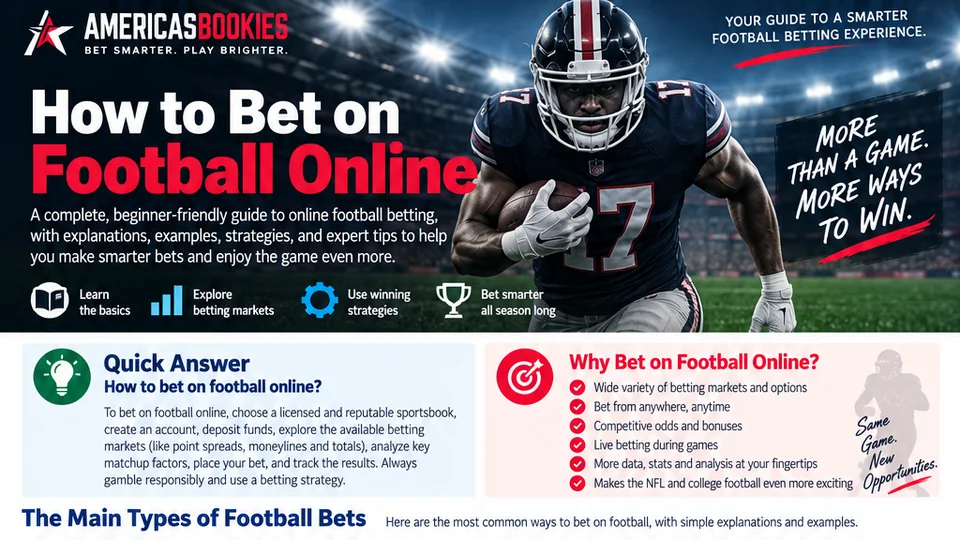
Online football betting starts with more than picking a team. You need to understand the market, the line, the price, the stake, and the conditions that make the ticket win. This guide walks through the process from opening a sportsbook to reading spreads, totals, moneylines, props, parlays, and live bets for NFL and college football.
How online football betting works
An online sportsbook is a website or app that posts betting markets, accepts wagers, grades the results, and maintains your account balance. The interface may look different from one operator to another, but the basic path is similar: identify a game, choose a market, click the selection, enter the amount you want to risk, review the odds and potential return, then confirm the ticket.
The important part is that the market selection comes before the bet button. A football matchup can have dozens or hundreds of betting choices. Two bettors can have the same opinion about which team is stronger but place completely different wagers. One might lay a point spread, another might take the favorite on the moneyline, and a third might bet an opponent team total Under because the defensive matchup is the real source of the opinion.
That is why learning how to bet on football online is partly a lesson in using a sportsbook and partly a lesson in translating a football opinion into the right market. The ticket should reflect the specific thing you believe is mispriced.
Step 1: Use a legal sportsbook where online betting is available
Sports betting laws and operator availability vary by jurisdiction. Use only a licensed sportsbook that is legal and available where you are physically located, and make sure you meet the applicable minimum age. Legal books generally require identity verification and may use geolocation before accepting a wager.
Before depositing, review the sportsbook's payment methods, withdrawal process, house rules, account controls, and responsible-gambling tools. If you are evaluating operators, the site's sportsbook reviews explain product differences without requiring you to place a bet.
Step 2: Create and verify the account
Online sportsbooks usually request basic identity details and may ask for additional documentation if the automated verification process cannot confirm them. This is normal in regulated gambling environments. Account information should match your payment information, and you should use your own account rather than betting for another person.
Step 3: Fund the account and set limits first
Deposit only money that is already part of an entertainment budget. A useful habit is to set deposit or spending limits before the first bet rather than waiting until a losing session. The goal is to decide the maximum financial exposure while you are calm, not while a game is on and the next market is one tap away.
Step 4: Find the football game and market
Open the NFL, college football, or football section of the sportsbook. A game page usually begins with three core markets—spread, moneyline, and total—then expands into quarters, halves, team totals, player props, alternate lines, same-game parlays, and live options.
Step 5: Add the selection to the bet slip
Tapping a price sends the selection to the bet slip. The slip should show the exact team or player, the market, the current odds, your stake, and the potential return. If the line has moved since you selected it, the book may ask you to accept the updated price. Read our bet slip guide if any field is unfamiliar.
Step 6: Confirm, track, and let the book settle the wager
Once confirmed, the ticket appears in your open bets. After the game or stat is official under the sportsbook's rules, the book grades the ticket as a win, loss, push, void, or another settlement status. A winning ticket normally credits the return to your account balance automatically. Do not confuse a pending ticket with a losing one; props and unusual game endings can take longer to grade.
The main types of online football bets
Football has many markets, but most beginner activity can be understood through a few core categories. Learn these first and the more specialized markets become easier to read.
| Market | Example | What has to happen? | Typical use |
|---|---|---|---|
| Point spread | Favorite -3.5 | Favorite must win by 4+ | Price the margin of victory |
| Moneyline | Underdog +160 | Underdog must win outright | Pick the winner without a spread |
| Total | Over 47.5 | 48+ combined points | Bet on game scoring |
| Team total | Team A over 24.5 | Team A scores 25+ | Isolate one offense/defense matchup |
| Player prop | QB over 275.5 pass yards | QB records 276+ | Bet on an individual statistic |
| Live bet | Second-half spread | Depends on updated market | Bet after the game starts |
How point spread betting works
The point spread gives one team a handicap and the other a head start for betting purposes. If Team A is -3.5, it must win by at least four points for a bet on Team A to cover. If Team B is +3.5, it can win the game outright or lose by three points or fewer and still cover the spread.
Spreads are often paired with a price near -110 on each side, although that is not guaranteed. The spread and the odds are separate pieces of information. A book might move a team from -3 -115 to -3.5 -105, for example. That changes both the win condition and the price, so comparing only the number or only the odds can miss part of the market.
Whole-number spreads can create a push. If you bet -3 and the team wins by exactly three, the sportsbook will generally return the stake, subject to its rules. Half-points prevent that exact tie. Bettors sometimes call the half-point a hook.
Why football bettors talk about key numbers
Some final-score margins occur more often than others because football scoring commonly arrives in threes and sevens. That makes numbers such as 3 and 7 important when comparing spreads. Moving from +3 to +3.5 can be more meaningful than moving from +4 to +4.5 because the extra half-point crosses a common margin.
This does not mean every +3.5 is automatically a good bet. The price, teams, rules, and your probability estimate still matter. It simply explains why seemingly small line changes can have different practical importance.
How football moneyline betting works
A moneyline removes the spread and asks only which team wins. Favorites usually have negative American odds and underdogs positive odds. If a favorite is -200, a $200 stake would make $100 of profit at that scale. If an underdog is +170, a $100 stake would make $170 of profit if the underdog wins.
The convenience of the moneyline can hide the most important question: what price are you paying? A dominant favorite may be very likely to win but still offer poor value if the odds require an even higher win rate than you believe is justified. Conversely, an underdog does not become a good bet simply because the payout is larger.
For a deeper explanation of plus and minus prices, use our guide to what moneyline means in betting.
How football totals work
A game total, also called an Over/Under, is a line on the combined score of both teams. If the total is 47.5, an Over bet needs 48 or more points; an Under needs 47 or fewer. You do not need to predict which team wins.
Totals are influenced by offensive efficiency, defensive matchup, pace, coaching decisions, quarterback play, injuries, weather, field conditions, and how likely the game script is to create extra possessions. A fast offense facing another aggressive offense can produce a very different total environment from two teams that play slowly and lean on defense.
The market already knows obvious information. Rain, wind, a backup quarterback, or a weak defense can move the total before you see it. The relevant question is not whether a factor exists but whether the current number fully reflects it.
Team totals, halves and quarters
Online sportsbooks commonly break a football game into smaller pieces. A team total asks whether one team will score more or fewer than a posted number. First-half and second-half markets apply a spread or total only to that period. Quarter markets are even narrower.
These bets can be useful when your opinion is specific. If you believe one offense has a major matchup edge but are less certain how the opponent will score, a team total may express that view more directly than a full-game Over. If you expect a strong scripted start from an offense but are worried about late-game pace, a first-half market might fit better.
The tradeoff is that smaller segments generally have fewer possessions, so one turnover, special-teams play, or red-zone stop can have an outsized effect.
Player props in online football betting
Player proposition bets focus on individual statistics instead of the final score. Common categories include passing yards, passing touchdowns, rushing yards, receiving yards, receptions, longest completion, anytime touchdown, and defensive or kicking statistics where offered.
Props require you to understand both talent and opportunity. A wide receiver's yardage projection can change because of target share, route participation, opposing coverage, expected game script, quarterback health, and whether the team is likely to play from ahead or behind. A running back can have an excellent matchup but still be a risky Over if the workload is split with another back.
Always read the grading rule. Sportsbooks can differ on what counts for a player's action if that player starts but leaves early, is active but does not participate, or is involved in a game that is suspended or otherwise unusual.
Parlays and same-game parlays
A parlay combines multiple selections into one ticket. Every required leg generally has to win for the parlay to cash, so the potential payout rises as more legs are added while the probability of winning the entire ticket falls. Same-game parlays combine outcomes from one matchup, such as a spread, player yardage prop, and touchdown scorer.
The appeal is obvious: a small stake can produce a larger advertised return. The risk is equally important. Adding a leg that you would not bet by itself can make the overall ticket worse, not better. Sportsbooks also adjust same-game parlay pricing when outcomes are correlated.
If you use parlays, treat them as a distinct high-variance product rather than a shortcut to making ordinary picks more profitable. Our parlay betting guide explains combined odds and probability in more detail.
How to read football odds and calculate payouts
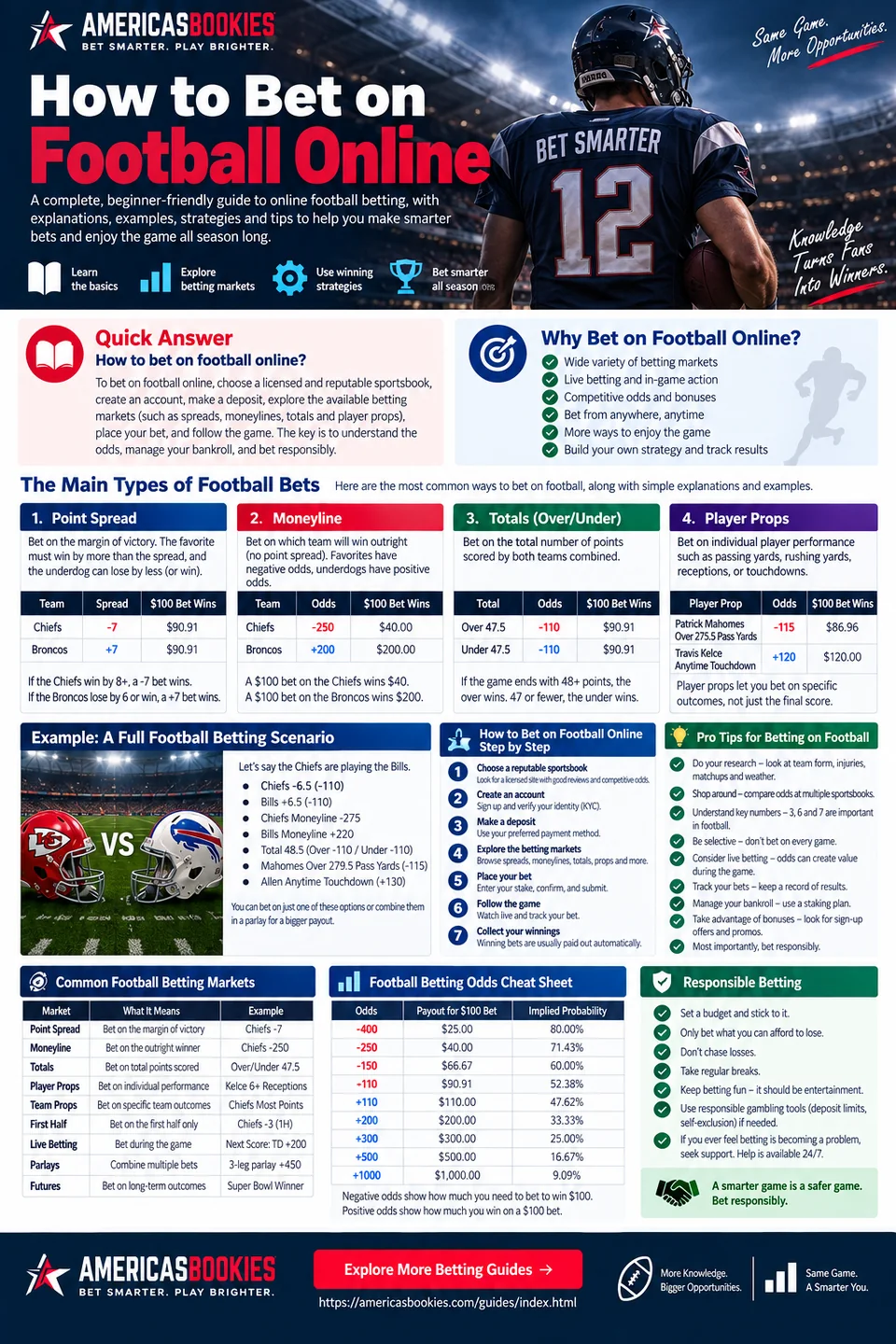
Most U.S. football sportsbooks default to American odds. A negative number shows the amount you would need to risk to make $100 of profit at that scale. A positive number shows the profit a $100 stake would make. Your actual stake can be any permitted amount; the sportsbook calculates the return proportionally.
| Odds | Profit on $100 stake | Total return | Approx. implied probability |
|---|---|---|---|
| -250 | $40.00 | $140.00 | 71.4% |
| -150 | $66.67 | $166.67 | 60.0% |
| -110 | $90.91 | $190.91 | 52.4% |
| +100 | $100.00 | $200.00 | 50.0% |
| +150 | $150.00 | $250.00 | 40.0% |
| +250 | $250.00 | $350.00 | 28.6% |
Positive odds formula
For positive American odds, estimated profit equals stake × (odds ÷ 100). A $40 stake at +150 would make $60 of profit, for a $100 total return if it wins.
Negative odds formula
For negative American odds, estimated profit equals stake × (100 ÷ absolute value of odds). A $55 stake at -110 would make $50 of profit, for a $105 total return if it wins.
Remember that profit is the money won above your original stake. Total return normally includes the returned stake plus profit. Our guide to stake in betting explains the distinction in more detail.
A full online football bet-slip example
Imagine a fictional pro football matchup. Sportsbook A posts the favorite -3.5 at -110, the underdog +3.5 at -110, a game total of 47.5, and a quarterback passing prop of 269.5 yards. These are four different bets on the same game.
| Bet | Odds | $50 stake profit if it wins | What makes it win? |
|---|---|---|---|
| Favorite -3.5 | -110 | $45.45 | Favorite wins by 4+ |
| Underdog +3.5 | -110 | $45.45 | Underdog wins or loses by 3 or fewer |
| Over 47.5 | -110 | $45.45 | 48+ combined points |
| QB over 269.5 pass yards | -115 | $43.48 | QB records 270+ passing yards |
You do not need to bet all four. In fact, one of the most useful online-betting habits is learning that a screen full of markets is a menu, not a checklist.
What to analyze before betting on football
Football handicapping can become complicated quickly, but a useful beginner process starts by asking which variables can materially change the market you are considering. A quarterback injury matters to nearly everything. A backup left tackle may matter more to pass protection and sack props than to an unrelated kicker market. Focus on information that changes the probability of the exact bet.
Quarterback play and availability
Quarterback news can create some of the largest line moves in football because the position touches passing efficiency, scoring, third downs, turnovers, pace, and how defenses approach the game. Confirm starting status when there is uncertainty, but do not assume every quarterback change is worth the same number of points. Supporting cast, scheme, backup quality, and opponent all matter.
Offensive line vs. defensive front
Protection and run blocking can reshape a matchup. An offense missing multiple linemen may have trouble sustaining drives even if its skill-position players are healthy. On the other side, an elite pass rush can force shorter throws, sacks, or hurried decisions. This interaction can matter to spreads, totals, quarterback props, rushing props, and live markets.
Injuries beyond the headline names
Football is highly interconnected. A missing cornerback can change how a defense handles an elite receiver. A linebacker injury can affect run defense and short passing. A tight end can matter as both a receiver and blocker. Look beyond fantasy-football stars and ask whether the replacement changes the unit's structure.
Pace, play volume, and game script
Teams that play quickly can create more possessions and more opportunities for points and statistics. Slow teams can shorten games. But pace is not independent of score: a team trailing by two touchdowns may speed up and throw more, while a team protecting a lead may run the ball and drain clock. This is why some player props are really bets on expected game script.
Efficiency instead of raw averages
Per-game points and yards are easy to find, but they can be distorted by schedule strength, overtime, turnovers, field position, and game state. Efficiency metrics—how well a team performs per play, per drive, or in specific situations—often provide better context. You do not need one magic model; you need measurements that match the question you are asking.
Turnovers and other volatile outcomes
Turnovers decide games, but they can also be noisy. A team with an extreme turnover margin may not repeat it at the same rate indefinitely. The same caution applies to defensive touchdowns, blocked kicks, unusually strong red-zone conversion, and other high-impact events. Do not blindly project recent outlier results forward.
Weather and field conditions
Wind is often more important to football betting than rain by itself because it can affect deep passing and kicking. Snow, extreme cold, heat, and poor field conditions can also matter, but the market may move quickly when forecasts become credible. Weather is an input, not an automatic Under signal.
Rest, travel, and scheduling
Short weeks, long trips, back-to-back road games, and unusual rest situations can influence preparation and player recovery. In college football, travel distance and conference schedules can create different patterns than the NFL. Treat scheduling as context rather than a standalone betting system.
How line movement works online
Sportsbook odds can change because of new information, respected betting action, broader market movement, or the operator's own risk and pricing. A spread may move from -2.5 to -3, a total from 48.5 to 47, or a moneyline from -130 to -145. The price attached to an unchanged spread can move too.
Do not assume every move tells you which team will win. Line movement tells you the market price changed. Your job is to decide whether the new price is still acceptable. If you liked a favorite at -2.5, that does not automatically mean you should like it equally at -3.5.
Why shopping for the best football odds matters
When more than one legal sportsbook is available to you, compare the same market before betting. One book might post +3.5 -110 while another has +3.5 -105. A favorite moneyline could be -145 at one operator and -155 at another. The underlying prediction is unchanged, but the better price improves the economics of the ticket.
Always compare like with like. A player prop at one book might use a different yardage threshold. An alternate spread is not the same market as the main spread. The best displayed odds are only useful if the win condition is identical.
For a detailed process, read the site's line-shopping strategy guide.
NFL vs. college football betting
The market names look similar, but NFL and college football can behave differently. NFL teams are more comparable in talent, information is usually widely distributed, and the market is highly liquid. College football has a wider range of team quality, playing styles, roster depth, and information quality, with far more games each week.
| Factor | NFL | College football |
|---|---|---|
| Talent range | Narrower; all teams are professional | Much wider between programs |
| Weekly game volume | Smaller slate | Very large slate |
| Market efficiency | Generally very high | Varies more by game and market |
| Roster turnover | Lower year to year | Higher due to graduation and transfers |
| Style variation | Still meaningful, but more standardized | Can be extreme across conferences and programs |
| Information | Broad media and injury coverage | Can be less standardized or complete |
The lesson is not that one league is easier. It is that your process should adapt. A college spread of three touchdowns is normal in a way that would be extraordinary in the NFL. Player availability and late lineup news can also be communicated differently.
How live football betting works
Live or in-play betting lets you wager after kickoff. Books update spreads, moneylines, totals, team totals, drive markets, and sometimes player props as game state changes. A turnover in the red zone, quarterback injury, missed field goal, or two-minute touchdown can move the market immediately.
The challenge is speed. The sportsbook receives data quickly, while the broadcast you are watching may be delayed. A line can move or suspend while the bet slip is open. Live betting also makes it easy to chase a pregame loss with a new wager. Treat each in-game bet as a separate decision with its own price and stake.
Our live and in-play betting guide explains latency, price changes, and cash-out mechanics in more detail.
Football futures: betting beyond one game
Futures are long-term markets such as championship winner, conference winner, division winner, season win total, or player awards. Because the ticket can stay open for weeks or months, the odds reflect not only current team strength but also schedule, injury risk, playoff path, and the time your money remains tied up.
A +1200 future is not automatically attractive because the number is large. Translate the price into an implied probability and ask whether your estimate is meaningfully higher after considering uncertainty. Futures can also be harder to compare if books use different rules for ties, qualification, or season disruptions.
Online football bonuses and promotions
Football season brings heavy sportsbook promotion, but a headline bonus is not the same as cash. Offers can include qualifying-bet requirements, minimum odds, maximum bonus amounts, expiration windows, bonus bets, odds boosts, and withdrawal restrictions. A promotion can be useful only if you understand the rules and would be comfortable making the underlying wager without pressure.
Never increase your normal stake simply to unlock a promotion. Read the sportsbook bonus guide and the promo terms glossary before treating promotional value as part of your betting decision.
Bankroll management for online football betting
Football schedules can create a weekly cycle of anticipation: Thursday night, Saturday college games, Sunday afternoon, Sunday night, and Monday night. That rhythm makes it easy to feel as though every television window needs action. Bankroll rules create a boundary between entertainment and impulse.
Start by defining a betting bankroll that is separate from rent, bills, savings, debt payments, and other essentials. Then choose a normal stake or unit that makes a losing streak financially tolerable. Some people use the same flat stake on most bets; others use a small percentage of their bankroll. The exact method matters less than consistency and affordability.
Do not double your stake after a loss because you want to get even before the late game. Chasing changes the risk profile precisely when emotion is highest. If a normal loss makes you feel compelled to recover the money immediately, the normal stake is probably too large.
Common mistakes when betting on football online
- Betting the favorite instead of the price. A team can be more likely to win and still be overpriced.
- Ignoring the difference between spread and moneyline. They answer different questions and can have very different payouts.
- Buying a narrative without checking the number. Injuries, weather, revenge angles, and trends may already be reflected in the line.
- Relying on win-loss records alone. Opponent strength and underlying efficiency can make two identical records very different.
- Adding parlay legs only to increase the payout. Every extra leg creates another way for the ticket to lose.
- Overreacting to one game. Football seasons have limited samples, which makes recent blowouts feel more meaningful than they may be.
- Ignoring price differences between sportsbooks. Small improvements can add up over many bets.
- Chasing live bets after a bad pregame result. The next market does not owe you a recovery.
- Betting every primetime game. Entertainment value is not the same as betting value.
- Forgetting settlement rules. Props, canceled games, player participation, and overtime can have market-specific grading conditions.
Football betting strategy: build a repeatable process
No football betting system can guarantee profit. A better goal is a decision process that is clear enough to review after the game. Write down why you believe a side or total is mispriced, the odds you accepted, the stake, and what information would have changed your decision.
- Start with probability, not the payout. Estimate how often the outcome should occur before deciding whether the price is attractive.
- Match the market to your opinion. A strong defensive view may fit a team total Under better than a side.
- Compare prices. Do not voluntarily pay more than necessary for an identical bet.
- Be selective. A full weekend of games is not a requirement to place a full weekend of wagers.
- Track closing prices where practical. It can help evaluate whether you consistently found better or worse numbers than the later market.
- Review process separately from result. A good-priced bet can lose, and a poorly priced bet can win.
If you want to explore price versus probability in more detail, see finding value bets and closing line value.
Responsible online football betting
Online betting reduces friction: you can place a wager from a phone without visiting a retail sportsbook. Convenience makes limits more important, not less. Decide in advance how much money and time you are willing to spend, use sportsbook limit tools when helpful, and take breaks when betting stops feeling recreational.
Only bet money you can afford to lose, never borrow to gamble, do not chase losses, and stop if betting begins to interfere with finances, relationships, work, or wellbeing. The responsible gambling guide explains deposit limits, time-outs, self-exclusion, and support options.
Online football betting terminology cheat sheet
| Term | Plain-English meaning |
|---|---|
| Point spread | A handicap that adds points to one team and subtracts them from the other for betting settlement. |
| Moneyline | A bet on the outright winner with no point spread. |
| Total / Over-Under | A bet on whether combined scoring finishes above or below a posted number. |
| Hook | A half-point on a spread or total, such as 3.5 or 47.5. |
| Push | A tie against a whole-number line that typically returns the stake. |
| Prop | A wager on a player, team, or game event other than the basic final result. |
| Parlay | One ticket combining multiple selections, usually all of which must win. |
| Live / in-play | A market offered after the game has started. |
| Alternate line | A different spread or total offered with a different price. |
| Stake | The amount of money risked on the wager. |
Frequently asked questions about betting on football online
How do you bet on football online?
Use a legal online sportsbook available in your location, create and verify the account, fund it with money set aside for entertainment, find the football game, choose a market, compare the odds, enter a stake, and review the bet slip before confirming. The most common markets are point spreads, moneylines, totals, props, parlays, and live bets.
What is the easiest football bet for beginners?
The moneyline is usually the easiest to understand because you are picking only the winner. That does not mean it is automatically the best value. The odds still determine the break-even probability and potential payout. Point spreads are also straightforward once you understand what covering the spread means.
What does -3.5 mean in football betting?
A team at -3.5 must win by at least four points for the spread bet to win. The opponent at +3.5 can win outright or lose by no more than three points and still cover. Because the line includes a half-point, there cannot be a push.
What does over 47.5 mean in football betting?
Over 47.5 wins if both teams combine for 48 or more points. Under 47.5 wins if they combine for 47 or fewer. Overtime commonly counts toward full-game totals, but you should always check the sportsbook's market rules.
Can you bet on NFL player props online?
Where legal and offered, online sportsbooks can post passing, rushing, receiving, touchdown, kicking, and other player props. Availability, limits, and rules vary by operator and jurisdiction. Check the player's participation requirements and the exact statistical source used for grading.
Can you bet after a football game starts?
Yes, many sportsbooks offer live betting. The spread, total, moneyline, and other markets can change as the score, time remaining, possession, injuries, and game state change. Prices move quickly, and your broadcast may be delayed relative to sportsbook data.
What should I check before placing a football bet online?
Confirm the exact market and line, current odds, stake, potential return, game time, injuries, quarterback status, weather if relevant, and settlement rules. Compare the identical market at another available sportsbook when practical, especially around key spread numbers.
Is online football betting legal everywhere in the U.S.?
No. Laws, legal operators, age requirements, and allowed bet types vary by state and jurisdiction. Use only licensed sportsbooks where sports betting is legal and available to you, and follow local requirements.
Keep learning
Football betting gets easier when the market, price, and win condition are all clear.
Continue with odds, bet types, moneylines, bankroll management, live betting, and sport-specific references in the complete America's Bookies betting guides library.